Archive
Breitling Montbrillant 01 Limited, writing a new chapter of the chronograph
Breitling is writing a new chapter in the history of the Montbrillant chronograph by equipping it for the first time with Caliber 01, a high-performance movement entirely developed and produced in the company workshops. A limited series completely dedicated to style and accomplishment.
Endowed with a look inspired by the 1940s and 50s and featuring a circular slide rule for pilots, the Montbrillant chronograph was named after the building on Montbrillant Street, in the heights of La Chaux-de-Fonds, which housed the Breitling workshops from 1892 to 1979. It was in these premises that the brand developed the inventions and improvements that were to change the face of the wrist chronograph, including the first independent pushpiece (1915), the second independent pushpiece (1934) and the first selfwinding chronograph (1969). This was also where Breitling produced its first onboard chronographs that contributed to its status as “official supplier to world aviation” during the boom of air transport on propeller-powered and subsequently jet aircraft.
Today, the Montbrillant is associating its name with another milestone in the history of the brand with the winged B by hosting Breitling’s Caliber 01, the most reliable and efficient of all selfwinding chronograph movements, produced using a revolutionary assembly process. The Montbrillant 01 Limited is issued in twin editions of 2,000 in steel and 200 in red gold, with the individual number engraved at 9 o’clock on the case middle. The Mercury Silver dial features elegant hands, the traditional central hundredth of a second counter, and an 18K gold version of the stylized B that served as the brand symbol until the mid-20th century. A transparent sapphire crystal caseback provides generous views of Breitling’s Caliber 01, chronometer-certified by the COSC (Swiss Official Chronometer Testing Institute), with its column wheel and its original structure. A collector’s piece for all those with a love of history in movement.
Movement – Breitling Caliber 01, officially chronometer-certified by the COSC, selfwinding, high-frequency (28,800 vibrations per hour), 47 jewels. Over 70-hour power reserve. 1/4th second chronograph, 30-minute and 12-hour totalizers. Calendar.
Case – Steel or 18K red gold. Diameter 40 mm.
Dial – Mercury Silver.
Water-resistant – to 3 bars.
Bezel – Bidirectional rotating bezel (slide rule).
Crystal – Cambered sapphire crystal, glareproofed on both sides. Transparent sapphire crystal caseback.
Straps/Bracelets – Barenia leather, crocodile leather/ Air Racer or Navitimer (steel only).
Source: Breitling
Fonte: Luxury & Fine Timepieces – Facebook
Maurice Lacroix Masterpiece Roue Carrée Seconde, mechanical technology
Success breeds success. Last year, Maurice Lacroix set a cat amongst the pigeons in mechanical watchmaking by developing a square wheel mechanism – the first in watchmaking history. Quite apart from its sheer aesthetic appeal, it introduced a whole new way of marking the passage of time. This year, Maurice Lacroix’s Roue Carrée offers a fresh angle on the passage of time, by focusing on the seconds display. As a result, the Masterpiece Roue Carrée Seconde is a truly fascinating spectacle to behold.
Designed by watchmaker and engineer Michel Vermot in collaboration with the Haute Ecole Arc du Locle, the square wheel mechanism has taken years to perfect. As the gear profiles of non-circular wheels cannot, by definition, be regular, the principal challenge was to define the shape of the teeth in order to ensure constant power transfer. The wheels were made using LiGA technology – a revolutionary process that combines the techniques of photolithography and electroforming to make high-precision micro-components that cannot be made with traditional machining methods.
The eye is mesmerized from the very first glance by the hypnotic movement of the Masterpiece Roue Carrée Seconde. The small-seconds display comes to life before your very eyes thanks to the steadfast, rhythmic movement of the square wheel with its geometric openwork. Its prominent phosphorescent corners serve as a reminder of time’s constant march onwards. The square wheel, whose corners and contours mesh with the same precision as its circular counterparts, is activated by a toothed clover-leaf wheel and turns continuously to create an extremely dynamic visual effect.
In order to leave the seconds hand firmly in the spotlight, the hours and minutes are indicated by a simple central hands coated with Superluminova. A power-reserve indicator at 3 o’clock adds balance to the picture. The hours, minutes and power reserve are displayed directly on the main plate, which serves as the dial. The watch’s readability is enhanced by its Grand Colimaçon (or snailed) black or rhodium finish, which makes the indicators literally glow, while the alternation of satin-brushed and polished finishes adorning the 43 mm steel case showcases its silhouette to perfection. A large sapphire-crystal case back reveals the refinement of the ML156 mechanical movement, decorated with Grand Colimaçon in finest Swiss watchmaking tradition.
The Masterpiece Roue Carrée Seconde – an unprecedented fusion of technology and talent – encapsulates the philosophy of Maurice Lacroix and its Masterpiece collection. A philosophy in which engineering and beauty dovetail to challenge the boundaries of design, in an attempt to change the very face of time. Resolutely masculine and eminently technical, this new item – a contemporary watch that breaks with preconceived ideas to stay ahead of its time – confirms the brand’s status as expert innovators. Galvanizing the most technical of watchmaking skills, it offers time a new lease of life.
Engineer and watchmaker Michel Vermot has taught at the Haute Ecole Arc, located in Le Locle (Switzerland), for 20 years. A specialist in mechanical and electronic watches, he has managed many industrial mandates in the framework of his role at the HE-ARC. He now runs the Movement Development Department at Maurice Lacroix.
Movement – ML 156 mechanical movement, hand-wound. Developed in collaboration with HE-ARC, manufactured and assembled by Maurice Lacroix. Design patented (square wheel / clover leaf). Vibration – 18,000 vph, 2.5 Hz. Power reserve – 45 hours. Jewels – 34. Adjustments – 5 positions after full winding and after 24 hours. Decoration – Grand Colimaçon, rhodium finish.
Movement Bridge / Dial – In keeping with the Masterpiece Régulateur Roue Carrée (*) design, the dial has been created on the main plate of the movement itself and is decorated with a large “Grand Colimaçon”. The square wheel and clover leaf mesh to transfer power with the same precision as the cogs in their circular counterparts; in addition the wheel is used to indicate the seconds. The hours and power-reserve indications are engraved on the main plate. Dial available in black or rhodium. The square wheel and clover leaf are highlighted by a circular opening on the movement main plate itself, decorated with a sandblasted background.
(*) Limited Edition launched in 2010.
Hands – Trailing square wheel for the seconds display, circular satin-brushed finish upper part and polished circumference, seconds pointer coated with white C1 Superluminova (blue luminescence). No visible rotation axis. Diamond-polished and faceted hours and minutes hands, coated with white C1 Superluminova (blue luminescence). Diamond-polished and faceted power-reserve hand.
Functions – Hours and minutes indicated by central hands. Small-second display by square wheel at 6 o’clock. Power-reserve hand at 3 o’clock.
Case – Steel, Φ 43 mm, satin-brushed and polished finish. Domed sapphire crystal with anti-reflective coating on both sides. Screwed case back with wide sapphire crystal. Water-resistant to 50 m / 5 atm.
Strap / Bracelet – Large-scale black crocodile-skin strap, lined with black calfskin and black over-stitching.
Buckle – Folding steel clasp with push buttons. Satin-brushed and polished finish.
Source: Maurice Lacroix
Fonte: Luxury & Fine Timepieces – Facebook
Audemars Piguet Jules Audemars Extra-Thin, exceptional timepiece
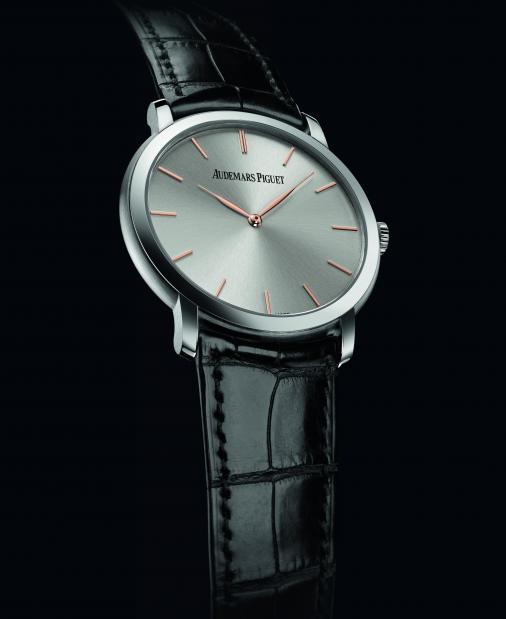
In 2011, Audemars Piguet has entirely reviewed the fundamentals of the Jules Audemars collection, its moon-phase calendar and dual timezone models, as well as its simple selfwinding watches including those with a date display. The Jules Audemars extra-thin watch houses one of the world’s thinnest selfwinding movements measuring just 2.45 mm thick. Its slender case, streamlined bezel and pure dial generate genuine emotion of the kind surrounding objects that are built to last, because this timepiece is endowed with that special something that is in fact the natural elegance of authentic classics.
A region, a culture: a collection
The models in the Jules Audemars collection represent the very roots of Audemars Piguet. This collection tells the story of an exceptional place and some exceptional people. The place is the Vallée de Joux, and the people are those who have nurtured Fine Watchmaking in this remote region. Well before the timepieces from this valley were exported to the four corners of the world, everything was already in place. From the mid-18th century onwards, alongside the farming work they undertook during the summer, the local population devoted many hours to building watch movements. They spent their long harsh winters at the workbench in order to fulfil orders from Geneva-based companies. They later began making their own movements and entire watches. The boldest of them founded manufactories, or Manufactures as they became known.
The men of the Vallée had thus acquired the ability to conduct the entire process, from design through to production, using hand-craftsmanship techniques. This dexterity, this manual know-how was handed down from generation to generation. Today it is accompanied by technological progress and semi-industrial-scale production, and yet the watches nonetheless embody deeply rooted origins and culture.
Jules Audemars and Edward Piguet became officially associated in 1875 and created the Manufacture Audemars Piguet. Both were watchmakers and accomplished masters of their chosen profession that they cherished and constantly perfected. Building on their knowledge, they played a pioneering role and took up the challenge of making entire watches under one roof. The company they established has been active ever since and has remained in the hands of the founding families.
The Jules Audemars collection pays tribute to this firm by bearing the name of one of the founders. It recounts this legacy and is imbued with a profound awareness of its heritage yet without any sense of nostalgia. It reinterprets the past with a contemporary vision. Its quest is focused on simplicity and a refusal of anything superfluous or purely ornamental. This unaffected simplicity is indeed what makes it both naturally elegant and unmistakably modern.
Absolute elegance, inside and out
The round case is an archetype that tends to make one forget that the circle is the perfect shape par excellence. By opting for an extremely slender bezel, the Jules Audemars extra-thin reveals the full measure of its innate nobility. The white gold case appears light and almost ethereal. This narrow bezel ensures a maximum dial opening. Only the applied pink gold baton-shaped hour-markers and hands stand out against the decidedly understated silver-toned background. Not even a minute circle disturbs this epitome of formal purity.
The case owes its clear-cut, sleek lines to the ultra-thin selfwinding movement within: Calibre 2120. Measuring just 2.45 mm thick, including the thickness of the oscillating weight, it is indeed one of the world’s thinnest self-winding movements. Audemars Piguet’s efforts to reduce the thickness of its movements began at an early stage in its history, and were already rewarded in 1946 with the hand-wound Calibre ML measuring just 1.64 mm thick. This was followed in 1953 by the skeletonised ultra-thin Calibre 2003. All that remained was to apply this successful approach to a selfwinding movement, a feat achieved in 1967 with Calibre 1967 and stemming from cooperation between several prestigious companies. It has since been constantly perfected. Its enduring appeal lies in an atypical, modern and refined nature. In addition to its extreme slenderness, it boasts the ingenuity of its winding system and of its balance-wheel adjustment.
One of the distinctive features of this Calibre 2120 is its rotor fitted with a 21-carat gold oscillating weight. This weight serves to drive the winding system in such a way as to keep the barrel at an ideal level of performance. The mainspring is able to supply its energy in a constant manner and thereby has a positive influence on rating procession. Enhanced performance was also the concern that motivated the choice of a central rotor rather an integrated mini-rotor. The barrel stands out from certain others in that it is as if “suspended”, held only by the barrel bridge. It ensures a 40-hour power reserve, a noteworthy achievement in light of the thinness of the movement and the construction of the barrel. The movement can be wound in either direction thanks to a reverser. To keep the movement as thin as possible, the oscillating weight is not equipped with a ball bearing mechanism and the endshake is guided by a peripheral ring rolling on four jewelled runners fixed to the mainplate.
This system makes a highly distinctive noise during the rotation of the oscillating weight, a sound that will delight connoisseurs. The heart of the movement is a variable-inertia balance with six inertia-blocks that ensure more stable long-term rating. It is equipped with a flat balance-spring and beats at the rate of 19,800 vibrations per hour.
Calibre 2120 is also remarkable in terms of the extreme care lavished on crafting it. Manually assembled and decorated in the company workshops in Le Brassus, it is distinguished by the exceptional quality of its execution and finishing. The bridges are meticulously bevelled and polished so as to feature only cleanly-cut, gleaming edges. The jewel sinks are diamond-polished. The wheels have bevelled spokes and diamond-polished sinks. Even the screw rim and slots are bevelled. The mainplate is circular-grained on both sides – with two different diameters of circular graining so as to accentuate the depth effect – and the bridges are adorned with Côtes de Genève. The beauty of the oscillating weight, which is openworked to form the “AP” initials, sets the crowning touch to the decoration of this calibre.
Those who appreciate rare objects will marvel at this meticulous finishing work in admiring the movement through the sapphire crystal case-back. They will rediscover the pleasure of the infinitely small details that one keeps to oneself. And finally, in the Jules Audemars extra-thin watch, they will recognise the force of character capable of withstanding the changes of time and which represents the enduring strength of authentic great classics.
Movement – Proprietary ultra-thin, selfwinding Calibre 2120. Total diameter 28,40 mm (12 ¾ lignes). Casing diameter 28 mm. Thickness: 2.45 mm. 37 jewels. 214 parts. Power reserve – up to 40 hours. Cadence of the balance – 19,800 vibrations per hour (2.75 Hz).
Finishing – All parts finished by hand; mainplate rhodium-plated, bevelled and circular-grained; bridges adorned with Côtes de Genève.
Functions – Hours and minutes.
Case – 18-carat white gold. Diameter 41 mm. Thickness 6.7 mm. Water resistance – 20 m. Sapphire crystal.
Dial – Silvered with applied pink gold hour-markers. Pink gold hour and minute hands.
Strap – Hand-sewn black crocodile leather with large square scales, secured by an 18-carat white gold pin buckle.
Source: Audemars Piguet
Fonte: Luxury & Fine Timepieces – Facebook
Andersen Rodinia, orologio universale
Andersen Genève è celebre per i suoi orologi ore del mondo: “Communication 24″ nel 1985, “Christophorus Columbus” nel 1992 e “Mundus” nel 1984 – l’orologio con ore universali più piatto del mondo – per citare solo i principali modelli.
In occasione dell’edizione di Baselworld 2011, Svend Andersen presenta Rodinia o “Revolution of evolution”, la sua 12a creazione della collezione World Time. In geologia, Rodinia è il nome di un supercontinente che si formò e poi si frammentò 1.100 milioni di anni fa, e che conteneva la maggior parte se non tutte le masse continentali di quel periodo.
Andersen Genève ha dato nuovamente forma a questo supercontinente al centro del proprio segnatempo. Il quadrante centrale in oro blu ruota su se stesso una volta al giorno e indica i 24 fusi orari in corrispondenza dei nomi delle 30 città più influenti del nostro secolo. Un modo elegante di celebrare il tempo qui e altrove, oggi come ieri.
Movimento – Meccanico a carica automatica, calibro Technotime AG 600, riserva di carica di 120 ore.
Funzioni – Ora, minuti e 24 fusi orari.
Cassa – Oro rosa e oro bianco (18 carati), 42,40 mm.
Quadrante – Centro in oro blu. Indicazione dei 24 fusi orari. Contorno bianco con indicate le 30 città.
Vetro – Zaffiro.
Impermeabilità – 30 m.
Cinturino/Bracciale – Pelle nera con fibbia ad ardiglione.
Source / Fonte: Andersen
Fonte: Luxury & Fine Timepieces – Facebook
Jaeger-LeCoultre High Jewellery and Art Watches
Sublimazione della meccanica. Esaltazione del savoir-faire manifatturiero. Emozione e attesa. Fascino e desiderio. La sfida quotidiana che affrontano gli artigiani della Manifattura Jaeger-LeCoultre è immensa. Ognuno esperto nella propria arte, questi artigiani riuniscono il proprio talento per comporre le più straordinarie sinfonie. Gioiellieri, smaltatori, bulinisti, incisori e orologiai hanno il dono di creare l’alchimia tra tecnica ed estetica, fondello e forma, ingranaggi e decori, che infondono in ogni orologio anima e passione. Come un libro aperto sugli arcani dell’arte, le novità 2011 raccontano l’incontro dell’uomo, del Bello e del tempo e incidono la loro storia nell’eternità.
Scintillante sfilata, la madreperla naturale, l’avventurina, i diamanti, lo smalto e le piume accompagnano con grazia e sofisticazione i tourbillon, i calendari perpetui, le ripetizioni minuti e altre indicazioni giorno/notte. La nuova collezione Master Lady propone una lettura raffinata del tempo declinata al femminile. Gli esemplari smaltati coniugano oggi un’arte secolare le cui lettere della nobiltà s’iscrivono a mano, con una minuzia spinta all’estremo. Gli orologi da uomo offrono alle complicazioni orologiere della Manifattura una nuova esecuzione, immagine del tempo: infinitamente preziosa. Ogni novità, a suo modo, rende omaggio a questi artigiani manifatturieri che hanno attraversato le epoche e continuano ad arricchire il patrimonio di Jaeger-LeCoultre con la loro creatività.
Collezione Master Lady: l’eterno femminino
La silhouette è morbida, le rotondità sensuali, l’eleganza innata. Gioco della seduzione, la nuova collezione Master Lady propone i suoi ornamenti più belli. Senza tempo, la sua forma gestisce le ore in un eterno girotondo. Le dimensioni della sua cassa, vestita d’acciaio, d’oro rosa o d’oro bianco, si adattano ai polsi più delicati. Una fila di diamanti taglio brillante ne sottolinea il profilo fino alle anse, che giocano con raffinatezza in una nuova estetica che accentua sempre più la femminilità di questo segnatempo. Omaggio al tempo, un diamante invertito sottolinea la corona. La lunetta tempestata illumina un volto raffinato su cui sovrastano generose lancette smussate. Mentre il chemin de fer delle ore esibisce numeri contemporanei in tutta rotondità, il quadrante è impreziosito, a seconda dei modelli, da un guilloché centrale circolare, da un intarsio in madreperla, da diamanti o piume. Dietro la grazia e la purezza che emana la collezione disponibile su bracciale di satin o d’oro incastonato, si cela un cuore meccanico a carica automatica realizzato nella più pura tradizione dell’Alta Orologeria.
Il Master Lady Night & Day dedica i suoi 29 mm di diametro a un’indicazione giorno/notte, animata a ore 6 dal Calibro Jaeger-LeCoultre 967A. Il lato iridato dalla madreperla è illuminato dai diamanti, una raffinatezza che valorizza le funzioni orologiere.
Dotati del celebre Calibro Jaeger-LeCoultre 978, i segnatempo Master Lady Tourbillon, Master Lady Tourbillon Wild e Master Lady Tourbillon Enamel dimostrano che la tecnica può anche declinarsi al femminile. Il primo offre un anello di diamanti al suo tourbillon per suggellare l’unione della bellezza e della meccanica. Il secondo esalta la complicazione orologiera con un incredibile ventaglio di diamanti, madreperla, avventurina e vere e proprie piume che si dispongono sul quadrante in uno spirito Art Déco. Il terzo invita la gabbia del tourbillon in un mondo vegetale smaltato secondo le regole dell’arte dove la natura si rivela vivace e radiosa.
Gli orologi smaltati: un’arte secolare al servizio dell’Alta Orologeria
Destinati a incontrarsi negli atelier della Manifattura, l’Alta Orologeria e l’arte dello smalto in miniatura condividono lo stesso amore per il dettaglio, lo stesso rigore, la stessa virtuosità d’esecuzione che si acquisisce solo al prezzo di un paziente lavoro. Entrambi guidati dalla mano, dall’occhio e dal cuore, orologiaio e smaltatore fanno della minuziosità il loro complice migliore per creare capolavori di miniaturizzazione. Tra tutte le tecniche ad oggi conosciute, la pittura in miniatura su smalto rappresenta probabilmente la forma più riuscita di questa antichissima arte. Le novità 2011 le rendono decisamente omaggio. Mettono in luce un processo di smaltatura che risale al Rinascimento, lo smalto traslucido, che si sposa con il guillochage per realizzare un sorprendente rilievo. Queste tecniche figurano tra le più preziose di tutte le arti pittoriche. Discipline che raramente vengono insegnate oggi, utilizzate solo da rari artigiani che perpetuano il proprio savoir-faire di generazione in generazione.
Nel paesaggio color bronzo del Master Minute Repeater risuona il suono cristallino dei gong che battono le ore, i quarti e i minuti. Unendo l’arte pittorica di un quadrante in smalto in miniatura con l’arte sinfonica di una delle più grandi complicazioni orologiere, il segnatempo è un concentrato di savoir-faire. La pittura in miniatura su smalto incontra il favore dei collezionisti per il suo immenso valore artistico e storico. La realizzazione del quadrante smaltato del Master Minute Repeater rappresenta un centinaio di ore di concentrazione e un gran numero di operazioni tutte delicate ed essenziali. Lo smaltatore deve inoltre dar prova di assoluta precisione per garantire il perfetto funzionamento del meccanismo orologiero e non superare le tolleranze minime dell’ordine di 2/10 di millimetro. Prima della vera e propria fase di pittura, prepara lo smalto bianco o traslucido e ricopre il retro della piastra del quadrante con uno strato di smalto che viene chiamato « controsmalto » destinato ad evitare deformazioni del metallo durante la cottura. Intraprende quindi il lavoro di decorazione applicando strati di colore con l’ausilio di un pennello estremamente fine che saranno successivamente passati al forno. Una testimonianza del talento degli artigiani smaltatori che non sarebbe completa senza una dimostrazione della maestria orologiera incarnata dal Calibro Jaeger-LeCoultre 947. Senza dimenticare di abbinare il fondello e la forma, il Master Minute Repeater lascia apparire a ore 4 i timbri della ripetizione minuti.
Nella versione incastonata, il Master Grand Tourbillon Enamel si diletta a giocare con le ombre e la luce per mettere in evidenza la sua grande complicazione. Incisa a mano sui lati, la cassa d’oro bianco costituisce uno scrigno su misura per accogliere uno dei fiori all’occhiello della Manifattura e una delle tecniche ornamentali più straordinarie. Nel cerchio di una lunetta incastonata di diamanti baguette, due gru cinerine si posano delicatamente sul quadrante blu notte precedentemente inciso. Realizzato secondo la tecnica dello smalto traslucido guilloché, questo esemplare aggiunge alla finezza del suo decoro in miniatura un effetto di incredibile profondità. Prima di posare gli strati successivi di smalto trasparente, l’artigiano realizza a mano un minuzioso guillochage sulla piastra metallica di base. Pone quindi uno strato di smalto bianco, il grisaille, sulla parte destinata a essere decorata. Dopo la cottura, lo smaltatore lavora con il « bianco di Limoges » usando l’ago o il pennello, con diversi strati e densità, per dare al materiale effetti di grigi e bianchi, ai quali può in seguito mescolare ossidi di colore. Come un trompe-l’oeil, lo smalto traslucido inciso evidenzia il minimo dettaglio del decoro con una precisione infinita: in un rilievo accentuato dalla luce che si riflette sui contorni dei disegni, il piumaggio degli uccelli, il movimento del collo, la raffinatezza del guilloché sono altri elementi in miniatura che danno letteralmente vita all’orologio. Vita che batte al ritmo delle oscillazioni del movimento a carica automatica Calibro Jaeger-LeCoultre 978.
Gli astri dell’arte orologiera di Jaeger-LeCoultre: un trionfo di luci
Tre modelli emblematici del savoir-faire di Jaeger-Lecoultre soccombono al fascino delle pietre preziose. Riunendo il talento dei suoi gioiellieri e dei suoi orologiai, la collezione celeste offre alle grandi complicazioni della Manifattura una nuova esecuzione infinitamente preziosa.
Dotato di una cassa in platino maestosamente coronata da diamanti baguette, il Master Gyrotourbillon 1 si concede uno sfavillante quadrante incastonato secondo la tecnica del rock setting, i cui diamanti baguette accuratamente disposti disegnano la volta della Cappella Sistina. A un livello inferiore, la volta celeste è maestosamente rappresentata da un cielo stellato in avventurina, intenso scrigno costellato da paillettes d’oro che accoglie in sé la magia gravitazionale del gyrotourbillon. Nato dall’immaginazione degli incastonatori della Manifattura, il rock setting rivela il fuoco dei diamanti baguette facendo scomparire totalmente il materiale che li contiene. Il mistero è totale, il segreto gelosamente conservato dagli artigiani di Jaeger-LeCoultre. Una scenografia all’altezza della complessità del movimento a carica manuale, il Calibro Jaeger-LeCoultre 177.
Integrando tre complicazioni che uniscono con eleganza le più fiere tradizioni a una tecnologia all’avanguardia (una ripetizione minuti, un tourbillon volante celeste e un calendario zodiacale siderale), nel Master Grande Tradition Grande Complication le pietre preziose disegnano i contorni della sua meccanica. Sontuosi diamanti baguette investono lo spazio della cassa lavorata in oro grigio mentre un camaïeu di zaffiri blu forma sul quadrante la carta celeste dell’emisfero settentrionale. Un anello girevole ornato anch’esso da diamanti e zaffiri aggiunge splendore all’insieme. Da non dimenticare il Calibro Jaeger-LeCoultre 945, i cui 527 pezzi sono tutti assemblati e regolati a mano da un unico orologiaio, per perfezionare la precisione del marchio.
Dotato del Calibro Jaeger-LeCoultre 978, un tourbillon automatico con gabbia in titanio e un bilanciere a grande inerzia, il Master Grand Tourbillon declina la sua sofisticazione in due versioni: una in oro rosa incastonato di diamanti taglio brillante, l’altra in oro grigio tempestato di diamanti baguette. Entrambe scelgono l’intensità dell’avventurina per mettere in scena la prodezza orologiera. Lavorata ad intarsio, la pietra semipreziosa rende iridescente il quadrante con una geometria rigorosa cosparsa di minuscole inclusioni d’oro che risplendono alla luce. Dietro le quinte, il Calibro Jaeger-LeCoultre 978, tourbillon automatico, freme con la necessaria regolarità, seguendo il va e vieni di una massa oscillante intagliata nell’oro.
Source / Fonte: Jaeger-LeCoultre
Fonte: Luxury & Fine Timepieces – Facebook
Cyrus Klepcys, incredible Babylon
The incredible Babylon: Babylon, the intellectual and scientific capital, ruled the world. The city of innumerable material and spiritual treasures also boasted magnificent architecture. But despite its reputable invincibility, the city was conquered. It was subdued by CYRUS the Great who, in contrast to the then military practices of the time, decided to preserve this jewel of destruction. CYRUS, as the man who arrived from barren lands and knew nothing of luxury, as the man who only drank water, succumbed to the enchanting city, the memory of which still excites our imagination.
The Klepcys collection has brought long-forgotten history back to life. Almost all the intellectuals and scientists of the era are united in this exquisite watch, which is only available in a limited series and whose owner will be its sole guardian.
This unique timepiece with reference to the Babylonian architecture and wealth inspires in us a certain lust…
The case design arouses in us the enthusiasm for CYRUS’s men and their emotions as they saw the walls of Babylon in the distance. Mighty, inaccessible, proud, and characteristic among thousands. Only Babylon can resemble Babylon. The watch sums up this notion with its design and selection of the highest quality materials. An imposing case with a diameter of 48 mm (including the crowns) boasts four walls in the shape of horns with high quality finish, and encompasses the main watch mechanism. The slanting lugs for a black crocodile leather band fit the wrist perfectly. The watch with a 18-carat red gold or 18-carat grey gold case combined with Grade 5 titanium with a DLC (Diamond Like Carbon) finish is available only in a limited series. The visible screws remind one of the three-part CYRUS brand logo and represent the ” locks ” of the walls of Babylon, which hide uncounted treasures waiting to be discovered.
The heart of the city – like the heart of the watch – contains a new and incredible wealth which is certain to amaze you. The mechanism provides three exceptional functions.
Imagine time as a line. The retrograde hand moves along the 180° axis and changes colour (while rotating the 180 degrees) depending on the time of day (day or night). Regardless of the hand’s position, the minute and second discs are always aligned and accurate during the linear reading of time. This patented alignment is based on a one-of-a-kind mechanism which controls the speed of the (retrograde and rotating) hour, minute, and second wheels.
Now, imagine the date. The units digits (from 0 to 9) rest one on top of the other, while the tens digits change before the units digits. Once the tens digit reaches the figure 9, the figure moves in retrograde and rotates by 90 degrees. It simultaneously opens the space for the next tens digit which is placed before the units digit 0. Another true patented technological discovery.
Finally, the tribute to the renowned Tower of Babel, the building ” with its top in the heavens “, should be mentioned: a full moon with realistic crater images which links the watch to the sky. The lunar phases are represented by a black patch which gradually covers the full moon. When the moon is fully covered, the three-section CYRUS brand logo becomes visible. Time eventually conquers the waning moon.
Three exceptional functions were developed in cooperation with Jean-François Mojon, the renowned developer who received the Best Watchmaker award at the Grand Prix d’Horlogerie in Geneva.
The watch face required precise and careful work as well. It mimics the shape of similar triangles. The three angles of the triangles resemble the three parts of the CYRUS brand logo. The logo is identical to the one in the centre of the product, the heart of Babylon, which, to our amusement, comes alive to the rhythm of passing seconds.
The case back of every Klepcys collection watch contains an identical copy of a more than 2,500-year-old COIN, fashioned during the reign of CYRUS. Today, the original is owned by the founders of CYRUS in Switzerland. The coin is a remnant of the first currency in the world; thus, it bears a great historic as well as financial value. All Klepcys watches bear the imprint of this very COIN containing the images of a lion and a bull, the indisputable symbols of authority during the reign of CYRUS.
The Klepcys collection products also bear a special message directed at the owner, imprinted around the coin:
” … Babylon is a city-state with a unique architecture and gathering all the technical and intellectual Know-How of its time … “
A magnificent city and an outstanding watch are hence conjoined.
You will feel incredibly proud when this precious watch adorns your victorious wrist and re-enchants your attitude towards time. Let the message engraved in the back of the watch immortalize this experience: ” Proudly made for demanding people. “
Babylon collection products are available in exclusively designed and exquisitely manufactured presentation cases. These are beautiful cases manufactured in the heart of Switzerland in a traditional carpentry shop by carpenters inspired by the very watches.
18K white gold with DLC-coated titanium case (black) model Limited Edition of 88 pieces.
18K red gold model Limited Edition of 33 pieces.
Description – Automatic movement with a unique display of the time on a movable axis, with a retrograde hour function, day/night indication, large date calendar with retrograde rotating three-dimensional tens, spherical moon with moon phase indication by gradual rise of a patch Swiss made.
Movement – CYR598 automatic, 4Hz, 28,800vph.
Power reserve – > 40 hours.
Number of components – 456.
Number of rubies – 37.
Crown position 0 – Manual winding.
Crown position 1 – Set time (possible only in a clockwise direction).
Full wind-up – 30 turns of the winding stem.
Time function – Three-dimensional retrograde display mechanism. Reading of hours, minutes and seconds on a movable axis with a day/night indication. Precise guidance of the retrograde height of the hour hand with a ruby bearing. Patent applied for.
Calendar – Large date, retrograde three-dimensional tens, pivoting. Precise guidance of the height of the tens hand with a ruby bearing. Patent applied for.
Phases of the moon – Three-dimensional moon. Progressive rising of the patch to indicate the various moon phases. In case of a fully covered moon: appearance of the CYRUS logo.
Oscillating mass – Customised décor on the mass. Ceramic ball bearings without lubrication.
Case – Diameter 48 mm (including crowns). Material – 18K white gold horns with DLC-coated titanium case (black) or 18K red gold (175 grams of gold). Coin (medallion) – 18 K red gold. Identical copy of the original, over 2,500-year-old coin. The original coin is the property of CYRUS.
Other details – Inertial balance for greater adjustment stability. Springs sized using FEM (Finite Element Method). Sprockets with optimised teeth (reduced play). Maximum use of stainless steel for better corrosion resistance. CYRUS-specific hardware.
Bracelet – Crocodile, sewn by hand, black or brown, tone on tone stitching.
Replacement bracelet – Crocodile, sewn by hand, black, tone on tone stitching.
Clasp – Black titanium clasp or 18K red gold folding clasp. Design inspired by the shape of the case. CYRUS logo on the cap.
Source: Cyrus
Fonte: Luxury & Fine Timepieces – Facebook
Perrelet Big Central Moonphase, marvel of precision
Being close to a distant object, taming a myth and possessing it in real time, Perrelet proposes this to all lovers and enthusiasts of fine watchmaking, thanks to its Big Central Moonphase.
Developed and manufactured exclusively by the Group’s Affiliate, MHVJ (Manufacture horlogère de la Vallée de Joux), the P-211 calibre is a marvel of precision. The exceptional interaction of the 3 technical components (carrier, starwheel and pinion) provides an exact indication that will not require correction (independently of the date) for more than 100 years, when working non-stop.
Proposed in a sober, refined manner, the imposing moon disc is synchronised with the hours, minutes, seconds and date with central hand. The cases housing this complication belong to the classic collection of the range. Recognizable by their fluting, they are fitted with an alligator strap with folding clasp which, with due attention to detail, continues the fluting feature on its sides.
You can be sure that in his quest for perpetual movement, Abraham-Louis Perrelet would have spent many hours of reflection, studying the unchanging cycle of the moon…
Movement – Automatic P – 211 Open-worked, exclusive decorated Perrelet rotor.
Power Reserve – 40 hours.
Vibrations per hour – 28’800 (4Hz).
Rubies – 29.
Case – Ø 42 mm.
Case material – Stainless steel. Anti – glare sapphire crystal (front & back).
Dial – Silvered white or Black.
Water resistance – 5 ATM.
Strap – Black alligator. Stainless steel deployment buckle.
Source: Perrelet
Fonte: Luxury & Fine Timepieces – Facebook
Corum Golden Bridge Automatic, strong impact
The mechanical Golden Bridge movement made a strong impact right from the time of its first presentation in 1980. Over 30 years ago, this exceptional baguette movement with its innovative construction wrote a new chapter in the history of watchmaking. Introduced in 2011 for the very first time is an automatic version – with linear winding – it heralds a new era in the legend of this unique movement. This world première of the automatic variation is presented in a red or white gold case and will be produced in limited quantities.
Few mechanical movements have had such a significant impact on horological history. The legendary Golden Bridge, first presented by CORUM in 1980, has since then revealed the full measure of its powerful and enduring appeal. This impressive baguette movement, built in a straight line and calling for exceptional watchmaking expertise, has adorned some of the most fabulous timepieces by the brand from La Chaux-de-Fonds. In 2009, the Golden Bridge baguette inspired the creation of the sophisticated and contemporary Ti-Bridge model, while 2010 saw the arrival of the first Golden Bridge tourbillon movement. In 2011, this amazing lineage is definitely entering a new era with the arrival of the self-winding Golden Bridge movement equipped with a linear oscillating weight.
The exclusive new CORUM Caliber C0313, an automatic linear-winding baguette movement, called for over four years of development and laboratory testing to verify the materials, the frictional forces and the physics of the winding mechanism. Equipped with a linear oscillating weight made in platinum and visible from both sides of the case, along with a slipping spring mechanism, this Golden Bridge movement beats at a frequency of 4 Hz (28,800 vibrations per hour) and is endowed with a 40-hour power reserve. This 194-part caliber is also fitted with a variable-inertia balance – guaranteeing long-term precision – as well as a barrel that is miniaturized so as not to break the smooth vertical lines of the mechanism. The mainplate and bridges are made from 18kt gold (matching the gold of each of the cases) and adorned with a new vertical guilloché motif matching the linear design of the oscillating weight and accentuating the powerful character of this in-line movement.
The complexity of such a movement – Caliber CO313 is one of the rare movements with linear oscillating weight on the market – lies first and foremost in resolving the inertia issues inherent to any movement of this type. Hence the use of a precious and dense metal, in this instance platinum, for this linear oscillating weight weighing 4 grams and which swings 1 cm, before its motion is slowed down or “damped” by a system of gaskets that send it swinging back in the other direction, thereby supplying the movement with all the energy it needs to continue moving.
The principle governing the development of CORUM Caliber CO313 was to offer a floating, linear oscillating weight floating on rails. The latter are made in steel with a PTFE Teflon coating, while the contact zones between the chariot and the rails are made from beryllium copper. This association of materials ensures optimal performance. The energy derived from the winding is transmitted via a rack fixed to the oscillating weight and constantly engaged with a reverser system – ensuring unidirectional winding – equipped with ceramic ball bearings and requiring no lubrication.
To accommodate this exceptional caliber, the new Golden Bridge Automatic has a new tonneau-shaped case in red or white gold which, at 37.2 x 51.8 mm, is larger than its predecessors and slightly curved to ensure optimal comfort on the wrist. It features alternating polished and satin-brushed surfaces, and provides superb views of the Golden Bridge self-winding movement – not only from both dial and case-back, but also from each of the sides. No less than four antiglare sapphire crystals are thus required to make a case that looks very much like a showcase housing a precious object. The two-part dial in black or white, depending on the version, conceals nothing of the fabulous mechanism and enables observers to admire the linear oscillating weight in motion.
Fitted with a crocodile leather strap fastened by a gold buckle, the new CORUM Golden Bridge Automatic will be issued in limited production runs in 2011, comprising 130 in red gold and 70 in white gold. This exclusive approach reflects the exceptional nature of the first ever automatic Golden Bridge movement.
Red gold 18kt Limited production 130 pieces.
White gold 18kt Limited production 70 pieces.
Movement – CO313. Automatic baguette movement with linear winding. Oscillating weight made of Platinum. Slipping spring mechanism. Variable inertia balance adjustable by screws. Frequency – 4Hz, 28’800 vibrations/hour. 26 jewels. Plate and bridges made of 18kt gold, guilloché decoration. Power reserve of 40 hours.
Functions – Hours, minutes.
Case – 37.2 x 51.8 mm. Tonneau-shaped case made of 18kt red gold 5N or 18kt white gold. Polished and satin-finished surfaces. Fluted crown at 6 o’clock decorated with CORUM key. Sapphire crystal open back cover under the movement.
Dial – Black or grey. Applique hour indexes. Skeleton hour and minute baton hands.
Glass – Sapphire crystal.
Water-resistance – 3atm (30 meters / 99 feet).
Strap – Black crocodile leather strap, hand-stitched.
Buckle Red gold or white gold tongue buckle.
Source: CORUM
Fonte: Luxury & Fine Timepieces – Facebook
F.P.Journe Octa UTC, Universal Time Coordinates
The Octa Collection reveals the UTC, Universal Time Coordinates
Created in the 19th Century, GMT, Greenwich Mean Time, originally referred to mean solar time at the Royal Observatory in Greenwich, London. Already used by the British navy to calculate their longitude position from the Greenwich meridian, it was introduced in the United Kingdom by the Railway Clearing House in 1847. It was then legally adopted as official time throughout Great Britain in 1880, and then in the entire world for the major part of the 20th Century, before being replaced in 1972 by UTC, Universal Time Coordinate.
GMT is usually used in the watch making world to designate watches with a second time zone. The two time measurements, even though close, do not coincide as GMT is based on terrestrial rotation, while UTC on atomic international time. UTC offers today a modern view of time zone division, for the majority, in full hours, directly linked to the real rotation of the earth and only slightly variable.
F.P.Journe innovates once again with the presentation of the Octa UTC ®, patented system that faithfully takes us back to the modern standards of determining time zones in full hours. Mechanically it indicates the different time periods linked with the earth’s geographical positions, indicating summer and winter hour.
On the dial, the main hours are indicated by the blue hands, and linked to the calendar indicating the main geographical time. The rose gold hand indicates the time zones on 24 hours, represented by the earth’s 24 time zones.
Utilisation
The time of the main geographical place is set by pushing the small secured pusher at 4h00. After having pulled the crown in position 2, the wearer is positions the second geographical region on 0 for winter hour. The gold hand is automatically and simultaneously positions itself at the corresponding time of this region. The +1 / -1 graduations’ purpose is to position the specific region for summer hour linked to the
geographical location of the user, depending if it’s positioned east or west of the chosen zone.
The mechanical movement with automatic winding is manufactured in 18K rose gold, like all F.P.Journe –Invenit et Fecit watch creations. It is constructed on the 1300.3 calibre, and offers an additional complication to the Octa line, still in the same calibre dimensions. The dial features off centre hours, minutes and seconds, a retrograde power reserve, a large date, and for the first time, a dial with the earth divided in time zones. The passing of the months from 28 to 31 days is done manually.
The Octa UTC also features the 22K red gold exclusive off centre rotor that winds in one direction only, thanks to a self-blocking ceramic ball bearing exclusive system. Every infinitesimal movement is thus maximally exploited for an optimized winding of the watch. In 2001, F.P.Journe presented the Octa collection composed of mechanical wristwatches with automatic winding featuring an exceptional power reserve of 5 days (120h), all with the same case thickness regardless of the complication.
Movement – Automatic Calibre FPJ 1300-3 in 18K rose gold (4N). Unidirectional automatic winding. Off-centre 22K gold guilloché winding rotor.
Three position crown – Correction of 24h time zones in position 2, clockwise. Correction of date in position 2, anti clockwise and. Correction of time in position 3. Instant jump calendar. Rotation of the earth by secured correction pusher at 4h. Number of jewels – 40.
Dimensions of the movement – Overall diameter 30.80 mm. Casing-up diameter 30.40 mm. Overall height 5.85 mm. Height of winding stem 3.00 mm. Diameter of stem thread S0.90 mm.
Indications – Off centre hours and minutes / off centre timezones / Small second at 4h30 / Earth dial divided in timezones at 7h30 / winter summer hour / large date / power reserve at 9h.
Decoration – Circular Côtes de Genève on 18K gold bridges. Circular graining on 18K gold baseplate. Polished screw heads with chamfered slots. Chamfered and circular grained wheels, diamond-moulded. Pegs with polished rounded ends.
Escapement – Escapement 15 tooth.
Balance – Four adjustable inertia weights. Anachron free-sprung flat balance spring. Mobile stud holder. Nivatronic laser soldered balance spring. Pinned GE stud. Frequency – 21’600 Alt/h, 3 Hz. Inertia – 10.10 mgcm2. Angle of lift – 52°. Amplitude – 0 h à plat : > 300°, 24 h à plat : > 280°. Autonomy – 120+/- 12heures.
Dial – Whiter or red gold. Hours and minutes, small second in silvered guilloché. Date display in silver.
Case – Platinum or red 18K gold. Diameter 38 or 40 mm. Height 10.6 mm.
Number of parts – Movement without dial 301. Cased up with strap 342.
Winding Speed – 274 anti clock-wise rotations per 24 hours.
Source: F.P.Journe
Fonte: Luxury & Fine Timepieces – Facebook
Urwerk UR-110 “Torpedo”
The UR-110 is a watch with attitude. From the base of its unusual asymmetrical case to the three arrow-shaped “torpedoes” flying in formation with the mission of indicating the time, the UR-110 has serious attitude.
Enveloped in a secure titanium case, planetary gearing keeps the three hour satellites in parallel formation as they take turns to indicate the time as they pass the 60-minute track. An “Oil Change” indicator alerts the user when it is time for a service; a “Day/Night” indicator helps keep track of changing time zones; and twin turbines on the back minimize wear in the automatic winding system.
This new complication is made possible thanks to a construction with three levels of complexity
– A central carousel providing the complication with stability and equilibrium.
– Planetary gearing assuring the parallel rotation of the three hour satellites as they orbit the dial.
– Three counter-rotating hour modules – each comprising an hour satellite, minute hand and counter balance – are each mounted on a planetary gear. These three modules are in constant counter-rotation to counter the direction of rotation of the central carousel.
The UR-110 continues URWERK’s radical tradition of telling the time using orbiting satellite complications. In the UR-110, the time is always shown on the right side of the watch. The satellites follow a vertical line, graded from 0 to 60 minutes, in a downward motion. The ingenuity of this layout lies in allowing the wearer to view the time discreetly and elegantly without the need to pull a cuff or sleeve back.
“The UR-110 is a logical evolution of our creations. We imagined time as a ‘silent journey’ where the hour satellites make a full rotation of the dial. But it is a velvet revolution; between rotation and counter rotations the effect is subtle and fluid. There are things happening on the dial that are not obvious at first glance. Everything looks normal; however, in fact they are everything but.” says Martin Frei.
“The beauty of the UR-110 is in its apparent simplicity. The development of UR-110 mobilized our entire team for nearly two years. Among the challenges posed by this complication was working out the optimal architecture for supporting the central carousel and the rotating hour modules. We finally opted for a technical solution that is radically different from any of our other creations: instead of ball bearings, a fixed axis runs the full height of the watch, providing maximum rigidity and minimum play. The whole complication is perfectly balanced on this axis ” explains Felix Baumgartner.
The UR-110 is a timepiece in which its technology can be appreciated though the large panoramic sapphire crystal. As well as indicating the hours and minutes, the UR-110 also features a Control Board on the dial side with indicators for “Day/Night” and “Oil Change” – URWERK’s service interval display, as well as small seconds on a sub dial.
The colour of metals prevails on the dial, a colour given pride of place on the predominately titanium case. The UR-110 is sober with few frills; its ornaments only apparent in the subtle perfection of its fine finishing. Turning the watch over, the titanium back encloses the innovative automatic winding system regulated by dual turbines.
The UR-110, micro-mechanics have never looked so good!
Movement – Calibre: UR 9.01 mechanical, automatic winding. Balance – Monometallic. Jewels – 46. Frequency – 28,800v/h, 4Hz. Balance spring – Flat. Power – Single barrel. Power reserve – 39 hours. Winding system – Uni-directional rotor regulated by double turbines. Finish – Matting, circular graining and diamond-cuts.
Indications – Satellite complication with rotating hour/minute modules mounted on planetary gears. Control Board – “Day/Night” indicator ; “Oil Change” alerting service intervals and small seconds.
Case – Case in Grade 5 titanium with bezel in 316L stainless steel. Dimensions – 47 mm X 51 mm X 16 mm. Two position crown with integrated protection. Water resistance – 3 ATM.
Source: URWERK
Fonte: Luxury & Fine Timepieces – Facebook



 LA PROMENADE Cult
- Valentino Garavani, muore l’imperatore della moda
- Crans-Montana, lutto oltre ogni possibile apparenza
- Italexit Per l’Italia Abruzzo – Marius Creati sostiene la famiglia nel bosco
- Giorgio Armani, muore l’ultimo re della moda internazionale
- Emilio Fede, muore l’ex direttore del Tg4
- Scuola.Zero – Progetto di Educazione Parentale, Francavilla al Mare (CH)
- Pippo Baudo, muore il re della tv italiana simbolo di Sanremo
- Ozzy Osbourne, muore il famoso frontman dei Black Sabbath
- 6a Biennale D’Arte Contemporanea di Salerno
- Alvaro Vitali, muore un volto noto della cosiddetta “commedia sexy all’italiana”

La Promenade du Temps
- Sedia neo barocca degli anni 50, un classico estemporaneo
- MERRY CHRISTMAS & HAPPY NEW YEAR 2025
- Allegra cornice artigianale con specchio fumé anticato d’antan
- Lampadario vintage in ottone e legno anni ’50 in stile neo vittoriano glamour
- “Una notte sul Titanic sul fondo dell’oceano…” incantevole letto d’antan anni ’40 in uno stile shabby materico tra profondo blu e tramonto solare
- Euforie di angioletti di gesso…
- Scudo con cranio di giovane cervo rosso, originale esempio di tassidermia in onore a Cernunnos
- Specchio impero anni ’40 su consolle vintage anni ’50/’60… en un ensemble encroyable!
- Putto decorativo tridimensionale très jolie in resina
- Testa di David, rivisitazione d’antan di un classico sempiterno

Les Fleurs de La Promenade
- “Quarantena” di Marius Creati
- Ciclo Corsini, estratto di poesie di Marius Creati
- “Padre mio” di Marius Creati
- Fashion Couture e Seduzione, disegni di moda di Marius Creati
- Fashion Couture e Seduzione, disegni di moda di Marius Creati
- “Segni”, poesia di Marius Creati
- Fashion Couture e Seduzione, disegni di moda di Marius Creati
- Fashion Couture e Seduzione, disegni di moda di Marius Creati
- Aforisma di Marius Creati
- Fashion Couture e Seduzione, disegni di moda di Marius Creati

LA PROMENADE Vip
- Crans-Montana, lutto oltre ogni possibile apparenza
- MERRY CHRISTMAS & HAPPY NEW YEAR 2025
- MERRY CHRISTMAS & HAPPY NEW YEAR 2023
- Ilary Blasi e Francesco Totti, amori in dissolvenza sinonimo di società liquida
- Madonna… il suo catalogo non è in vendita!
- Merry Christmas & Happy New Year 2021
- Robin Williams, svelata causa di morte del celebre attore
- Naomi Campbell, annuncio arrivo della sua prima figlia
- Merry Christmas & Happy New Year 2020
- Stella McCartney x Taylor Swif, capsule in arrivo con l’album Lover


MONDORARO
- Gaza: War ends where Humanity begins. Mostra di G.Karloff ad Alfedena da maggio ad agosto 2026
- Castel di Sangro, sviluppo e identità: l’opposizione non sia nostalgia
- Elodie e Franceska, un amore che non ha bisogno di etichette: la forza della libertà
- Quando il male diventa progetto: il caso del 17enne, la seduzione della violenza e la futilità distruttiva dell’odio
- Hannibal Lecter, il cannibale più famoso della fiction: differenze, errori e forzature tra film e romanzi
- Famiglia nel bosco, il libro di Catherine Birmingham e il dubbio inevitabile: il “risveglio” passa anche dal contratto editoriale?
- Castel di Sangro, perché mi piace la lista di Angelo Caruso: concretezza, visione e attenzione al territorio
- Pizzaballa fermato al Santo Sepolcro: Israele sotto accusa, Herzog parla di “incidente”
- Migranti Ue, il Parlamento apre ai rimpatri nei Paesi terzi: l’Europa sceglie la linea dura
- Noelia Castillo Ramos, addio a 25 anni: la sua eutanasia chiude una lunga battaglia per il diritto di scegliere


La Promenade by Marius Creati is licensed under a Creative Commons Attribuzione - Non opere derivate 3.0 Unported License.
Based on a work at lapromenademag.com.
Permissions beyond the scope of this license may be available at http://lapromenadenet.wordpress.com/la-promenade-network/.










 La Promenade, BlogZine di Informazione