Archive
Chanel J12 Marine Only Watch 2011, esemplare unico
Un’affascinante opera di alta orologeria nata per partire alla conquista delle più profonde oscurità degli abissi.
Stiamo parlando della nuova versione dell’orologio Chanel J12 Marine, ispirato sin dalla sua nascita ai simboli del mondo marino, attirando i più esigenti collezionisti e appassionati di orologi di lusso attratti dal mondo subacqueo.
Prende il nome di Chanel J12 Marine Only Watch 2011 ed è un esemplare unico creato appunto per Only Wacht; riporta lo stile di un classico orologio da immersione, mosso però da un movimento automatico e caratterizzato da una cassa in ceramica nera satinata, in perfetto stile high-tech.
Su alcuni dettagli dell’orologio, sono presenti particolari in oro rosa 18 carati per un totale di 81,62 grammi; l’impermeabilità è certificata fino a 300 metri ed il suo diametro da 42 mm lo porta ad essere perfettamente indicato per l’uso subacqueo professionale.
Le funzioni, inoltre, sono state studiate per supportare al meglio ogni tipo di esigenza quando si è immersi in acqua; attraverso la ghiera in ceramica, con marker luminoso a ore 12, è possibile monitorare ore, minuti, secondi e tempo d’immersione totale.
L’orologio è di una luminescenza davvero unica e le lancette sono anch’esse in oro 18 carati; la corona a vite in oro si presenta con un vistoso elemento in ceramica taglio cabochon.
Azzeccata anche la scelta del cinturino in gomma nera opaca e della chiusura ad ardiglione della fibbia; quest’ultima riporta la classica scritta Chanel.
Il ricavato di quest’orologio sarà interamente devoluto in beneficenza.
Per altre informazioni basta visitare il sito chanel.com
Fonte: GoLook.it
Audemars Piguet Royal Oak Offshore Selfwinding Tourbillon Chronograph
In order to grasp the essence of the Royal Oak Offshore Selfwinding Tourbillon Chronograph, you need to pick up the watch with your eyes closed and only open them after turning it over. Housed within a case that strongly hints at its innate sturdiness, protected by a sapphire crystal and a solid back secured by eight polished steel screws, a true masterpiece is revealed: the new selfwinding Calibre 2897, equipped with a tourbillon and a chronograph. A set of 335 parts on which the manually adjusted, corrected, bevelled and decorated surfaces create a shimmering play on light and shade. The automatic winding is ensured by a peripheral oscillating weight, while its chronograph is equipped with a column wheel and its tourbillon optimises its rating precision. The Royal Oak Offshore Selfwinding Tourbillon Chronograph is in harmony with the finest watchmaking traditions, and yet turning it over reveals an eminently contemporary spirit. It displays a sophisticated and powerful design, that of the legendary Royal Oak Offshore collection, supported by a combination of blackcoloured materials: forged carbon for the case middle, ceramic for the bezel and rubber for the strap. A watch with two faces, an encounter between contrasts or a watchmaking union of opposites, the Royal Oak Offshore Selfwinding Tourbillon Chronograph is an amazing blend of two worlds.
A 100% in-house made movement – Calibre 2897 is a selfwinding movement entirely developed and produced by Audemars Piguet. It combines a tourbillon and a column-wheel chronograph. Its architecture is a tribute to the past. The rounded cut-out of the bridges, the S-shaped lever, the curves of the minutes-counter bridge and the characteristic toothing of the column wheel: everything about this mechanism displays consummate artistry, to the point of making us almost forget the functional aspect. The finishing of the various parts is also loyal to the grand traditions of Fine Watchmaking. Several surfaces shine with a perfect polish, known as a mirror or specular polish, which catches the light and results in exceptional optical effects achieved by various polishing operations involving a succession of files, buffs, burnishers and various abrasives. On all the interior and external corners, the sharp edges between the surface and the flanks are cut down to form polished bevels. This is the meticulous operation known as bevelling or chamfering, and which is entirely performed by hand on all parts. The bridges and mainplate are rhodiumed, bevelled, circular-grained, beadblasted and hand-drawn with file strokes. After each of the parts is finished and decorated, the watchmaker performs a first “trial” assembly in order to set them into motion. Everything is then dismantled and each part is meticulously cleaned, before proceeding to final assembly and casing up. It takes around 15 days to produce a finished movement, which is then subjected to a number of different tests.
The peripheral oscillating weight, an efficient and elegant solution – Automatic winding is ensured by a peripheral oscillating weight in 950 platinum, mounted on ball bearings. This choice serves to shift the weight of the rotor to the outer edge of the movement, thereby improving winding speed. A recess has been made in the case middle so as to ensure that this 180° oscillating weight can rotate a full 360°. It is also worth specifying that this large 180° segment is optimally sized to enhance the efficiency of the automatic winding. Moreover, because of its position on the periphery of the movement, it does not increase the overall thickness, which enables the movement to maintain a slimmer profile. It also offers the additional aesthetic advantage of entirely freeing up the reverse side of the movement and thus providing full views of the mechanism, and particularly its column wheel, through the transparent back of the watch.
The tourbillon, the most entrancing of all horological complications – Very few watch brands are capable of making their own tourbilllons. An acknowledged member of this select circle, the Manufacture Audemars Piguet has become a master in the art of defying the effects gravity and has over 16 movements equipped with a tourbillon. In 1986, it was already the first brand to offer an ultra-thin selfwinding tourbillon wristwatch. Representing watchmakers’ response to the laws of gravity, this invention serves to cancel out the disturbing effects of gravity on the movement’s most sensitive organs – the balance and spring assembly and the escapement – and to thereby achieve enhanced timing precision. To compensate for these disturbances, these organs are housed within a tiny feather-light mobile carriage that spins on its axis once a minute. The tourbillon with its blackened titanium bridge is visible through a dial cutout at 6 o’clock. Setting this tourbillon into motion represents a formidable technical challenge. A weight of just 0.017 grams serves to balance the carriage weighing a mere 0.45 g. Meanwhile, in terms of the lightness of the regulating organs themselves, the escapement weighs just 0.12 g. The experienced watchmaker devotes almost three days to assembling its 85 parts, while the overall movement takes over 15 days.
The chronograph, a constantly perfected mechanism – Calibre 2897 reveal its column wheel, an attribute of the finest mechanical movements and which serves to coordinate the start, stop and reset phases. An ingenious coupling yoke principle has been developed in order to avoid the chronograph hand jerking when the timing begins, a characteristic flaw of this type of mechanism. The development engineers have added a hook to the coupling yoke which thereby displays enhanced shock resistance when the chronograph is activated. The meticulous assembly and adjustment operations are entirely performed by hand and require particular care. The activation of the chronograph functions is thus carried out progressively in order to enable gentle and accurate tactile perception.
The inimitable design of the Royal Oak Offshore collection – The name Royal Oak Offshore has become a watchmaking legend synonymous with sporty masculinity. Once again, connoisseurs will delight in recognising the octagonal bezel punctuated by its eight trademark polished steel hexagonal screws. The bezel is reinforced by the choice of black ceramics and by its finishing, in which the vertical satin-brushing of the surface makes a powerful contrast with the polished chamfers in order to sharp edges and clean-cut angles. The characteristically imposing and noble case middle is made from forged carbon. While ceramics is known for its resistance and hardness, forged carbon is extremely light. This material widely used in the field of aeronautics was introduced by Audemars Piguet into the world of fine watchmaking. The technical nature of the details on the right side of the case further accentuate the case middle. The pushpieceguards are not part of the case but consist of two titanium parts secured to the case by four visible screws. The pushpieces themselves are composed of two parts: a base and a top that serves as a contact surface. Finally, the dial features the signature “Méga Tapisserie” motif symbolising this collection, composed of straight parallel lines and taut shapes. Its 6 o’clock opening serves to reveal the tourbillon. Even the grooved rubber strap complies with the established Royal Oak Offshore codes.
Movement – Selfwinding Calibre 2897 with tourbillon and column-wheel chronograph. Total diameter: (15½ lignes). Casing diameter – 31.40 mm. Thickness – 7.75 mm. 34 jewels. 335 parts. 65-hour power reserve. Cadence of the balance: 21,600 vibrations per hour (3 Hz). Variable-inertia balance with screws and balance-spring with Phillips terminal curve. Finishing – All parts finely hand decorated; bridges and mainplate rhodiumed, circular-grained, beadblasted and hand-drawn with file strokes; polished angles, bevelled screw rims and slots. Peripheral oscillating weight in circular satin-brushed 950 platinum.
Functions – Hours and minutes. Small seconds at 9 o’clock. Chronograph with central sweep-seconds hand, 30-minute counter (at 3 o’clock). Tachometric scale on the flange.
Case – Diameter 44 mm. Thickness 14 mm. Sapphire crystal caseback with Royal Oak Offshore engraving.
Dial – Black with exclusive “Méga Tapisserie” motif, silver-toned counters. Applied and facetted white gold hour-markers with luminescent coating. Black flange. White gold facetted hour and minute hands with luminescent coating.
Strap – Black rubber, adorned with two grooves. Titanium pin buckle.
Source: Audemars Piguet
Fonte: Luxury & Fine Timepieces – Facebook
Rado D-Star Black Ceramic XL, ceramica high-tech
Questo cronografo da polso nero in ceramica high-tech a movimento automatico si distingue immediatamente per il suo look particolare, spiritosamente esaltato dalle lancette e dagli indici bianchi luminosi. L’orologio mette in risalto la forma unica della gamma con dimensioni extralarge e lo stile innovativo Rado nell’ormai diffusa popolarità degli orologi da polso neri.
Movimento – 11 ½ ETA 2824-2. Automatico. 25 gioielli. 3 lancette. Riserva di carica 38 ore. Movimento decorato, placcato giallo.
Cassa – Ceramica high-tech lucidata in nero. Parte centrale in acciaio, pressata sul retro in acciaio con cristallo in zaffiro. Corona in acciaio con cappuccio in ceramica nero. Dimensioni – La 42.0 x Lu 46.0 x Al 11.0 mm.
Quadrante – Nero opaco con disegno ad onde stampato. 12 indici applicati in giallo con parte luminosa in bianco. Logo giallo Rado e Automatic, e l’ancora simbolo del movimento.
Lancette – Gialle con parti luminose bianche.
Cristallo – Zaffiro a cupola.
Impermeabilità – 10 Bar (100 metri).
Bracciale – Ceramica high-tech nera a file, fibbia triplice in titanio.
Source: Rado
Fonte: Luxury & Fine Timepieces – Facebook
Rebellion REB-5 Tourbillon Manufacture, regal timepieces
With the REB-5, Rebellion Timepieces hauls that most noble and regal of horological mechanisms, the tourbillon, from its 18th century roots at kicking and screaming at high speed into the 21st century! Rebellion have now taken the tourbillon and made it their own! In making a complete revolution every 60 seconds, Rebellion’s one-minute tourbillon ensures high precision timekeeping and much more.
Abraham-Louis Breguet, the world’s greatest-ever watchmaker, invented the tourbillon over 200 years ago, to improve timekeeping by countering the effects of gravity on the oscillator. But rotating a tourbillon cage each and every minute consumes considerable energy. It explains why the majority of tourbillons suffers a relatively short power reserve. Rebellion’s REB-5, however, stands out from the crowd, both technically and aesthetically, by using twin mainspring barrels to provide a massive seven days of power! It is an achievement perhaps less surprising to the “Connaisseurs”, upon discovering that the movement was developed specifically for Rebellion by renowned Swiss master watchmaker, Laurent Besse.
Rebellion’s technically-exacting and innovative offering in a line of tourbillons going back two centuries as the presentation of a movement holistic with its bold case and dial architecture – a feat that attracts and excites the eye. In essence, the REB-5 has no dial: the top of the beautifully-finished open movement is the dial, enabling full visual access to the intricate working of the micro-mechanics usually hidden from view.
Turn the over-size crown and you can see the twin mainspring barrels winding, while a window on the side of the case ensures that the pulsing heart of the watch, the animated tourbillon and oscillator, can be appreciated in all their glory. Turning the watch over reveals a back as fascinating as the front, with the tourbillon, the two mainspring barrels, the wheel train and even the winding and time-setting mechanisms all completely open to view.
As with all of Rebellion’s timepieces, it is the attention to every detail that sets the brand apart: screw heads in the form of the brand’s helical logo, mainspring barrels engineered and even drilled to resemble the brake disks and wheels of a sports car – even the hands are open-cut so that no mesmerizing feature is hidden from sight.
The REB-5 is available in an extremely exclusive, limited edition of only 12 pieces per year.
Movement – REB-5, manual winding with tourbillon. Tourbillon one-minute rotation. Power reserve – 7 days from two mainspring barrels. Balance frequency 21’600 A/h (3Hz). Number of jewels 23. Dimensions – 38.25 mm x 36.7 mm. Diameter – 30 mm x 6 mm . Finishing galvanic black gold plates, gold plated wheels, blued and black gold screws, wolf-teeth barrels. Movements verified by in-house state-of-the-art testing laboratory.
Case – Modular construction. Materials -Available in red gold, black titanium DLC and titanium. Sapphire crystals compound curves, bevelled edges, anti-reflection coating both faces, side of case, display back. Dimensions – 46 mm x 56,7 mm x 19,6 mm.
Water resistance – 50 m for gold models. 100 m for titanium models.
Straps – Natural rubber straps with double folding buckle matching case metal.
Source: Rebellion
Fonte: Luxury & Fine Timepieces – Facebook
Zenith Captain Dual Time, status of commander
Captain: the very name calls up flights of fancy! It evokes long-distance travel, untamed seas, but also the fabulous fortunes made trading in distant outposts. The status of captain was, in the past, reserved for officers who commanded a royal vessel. Nothing of the art and skill of navigation at sea could remain a mystery to the man who aspired to this position. Captain is also a collection that embodies the highest expression of Zenith’s watchmaking heritage. It encompasses an expertise that, like navigation at sea, is passed on from one generation of watchmaker to the next within the Locle Manufacture. The new collection is enriched with three models with complications: power reserve, moonphase and second time zone.
The three new models are inspired by the Captain line created in 1952, a leading collection of Zenith automatic watches. The 2011 collection holds true to the course of the original models. All the expertise of watchmaking– technique, chronometric performance, and aesthetics – is integrated into these three creations that make clear allusions to historic timepieces, with dauphine hands, facetted with rhodium-plating and long markers that are hand-set. The case is enlarged to its present-day size of 40 mm. The development of this collection has been led by technical and chronometric achievement – just as it was 50 years ago. Equipped with Elite calibers, the models of the new generation benefit from an additional half-century of watchmaking experience. The manufactured movements, decorated with Côtes de Genève and circular-graining are visible through a sapphire case back.
Captain Dual Time – Let us leave the oceans for a moment to explore navigation in the air. Watches equipped with the GMT function are the direct descendants of the conquest of the skies. In 1955, Zenith presented a multi-time-zone watch intended for air pilots; this model was inspired by Zenith’s aerial navigation instruments that had been integrated into the dashboards of cockpits since 1920. The Captain Dual Time model is equipped with a GMT hand with a different design, with a blue pointer that ensures optimal readability. This hand is set using a push-piece at 10 o’clock. This mechanism makes it possible to adjust the second time zone with a simple gesture, without risking the deregulation of the time on the watch. The Captain Dual Time is available in two versions with a silver or black “Clou de Paris” guilloché dial, in a steel case, with a metal bracelet or alligator-skin strap.
Movement – Elite 682, Automatic. Caliber: 11 ½ “` (Diameter: 25.60 mm). Height 3.935 mm. Parts 158. Jewels 26. Frequency 28,800 V/h – (4 Hz). Anti-shock system. Regulator assembly with fine adjustment. Power reserve of over 50 hours. Automatic winding in both directions. Instant date change. Rapid date reset. Stop-seconds system for setting the time to the nearest second.
Decoration – Circular-graining on plates. “Côtes de Genève” or circular-graining and chamfering on the bridges. Strokes drawn on the hammers, levers and conveyors.
Oscillating weight – Central rotor on ball bearings. Metal oscillating weight with guilloché work in a “Côtes de Genève” motif and revelation of the ZENITH star through skeleton work.
Functions – Central hours and minutes. Small seconds at 9 o’clock. Second time zone indicator on 24h. Date indicator at 6 o’clock.
Case – Diameter 40 mm. Crystal – Sapphire glass treated with antireflection on both sides. Case back – Transparent sapphire glass.
Water resistance – 5 ATM / 50 meters.
Available models – Available in steel with silver or black guilloché dial on a brown or black alligator-skin strap, or metal bracelet.
Source: Zenith
Fonte: Luxury & Fine Timepieces – Facebook
Baume & Mercier Capeland Chronograph & Flyback Chronograph
The memory of a “galet” watch – The inspiration behind the contemporary reinterpretation of this collection is a historic timepiece – a single-push chronograph from 1948. With its “chevé” crystal and domed case back, this watch is a direct reference to the “galet” pocket watches of the early 19th century. Its ergonomic shape, accentuated by the aesthetically symmetric geometry of the top and bottom, is the primary source of inspiration for the design of the Capeland watch.
The suggestive strength of Capeland comes not only from its name. Everything about this watch suggests seaside living: the marked curve of its case back and crystal is an irresistible reminder of the soft contours of a sea-weathered stone. The shape of the horn, both short and elegant, further accentuates the roundness of the case.
Capeland is also distinguished by its two-toned dial, a subtle reminder of a 1950s aesthetic. A highly-accomplished watch, it includes both a tachymeter and a telemeter, while the case is adorned with polished and satined finishes. One further detail, Capeland is water-resistant up to 50 meters.
Watches with a relaxed and contemporary spirit – The heart of the collection, a chronograph for all models, promotes relaxed elegance with a light sporty feel marked by straightforward numerals and a touch of red on the end of the seconds hand and the telemeter. In this spirit, the calfskin strap with light-colored stitching stands out and harmonizes with the trendy color scheme used on the dial: slate gray, anthracite, coppercolored, brown, silver-colored, black and white.
Infinitely comfortable, Capeland perfectly hugs the wrist, an eloquent demonstration of Baume & Mercier’s expertise: a harmony between design and comfort for the wearer.
Spotlight on the emblematic pieces – A point of pride within the Capeland collection, these emblematic watches come equipped with a self-winding mechanical movement with a flyback chronograph function.
This Bi-compax movement, manufactured by Lajoux-Perret, is enriched with blued steel screws and a circular-grained finish for the plate and the bridges. Its sapphire crystal case back enables a view of the oscillating weight engraved with the brand’s emblematic Phi, further adorned with “Côtes de Genève” and snailed décor.
These exceptional watches distinguish themselves by a “chevé” crystal, a domed dial in retro colors, and “Breguet” type hands. Offered in two versions: stainless steel or 18 ct. red gold which shimmers like antique copper, these models come with a dark brown or black alligator skin strap which gives them a final touch of sophistication.
A mastered combination of historical inspiration and the powerful evocation of seaside living, Capeland is already a true Baume & Mercier classic.
Chronograph models
Movement – Automatic (Valjoux 7753).
Functions – Chronograph. Tachymeter. Telemeter. Date.
Case – Round. Diameter: 42 mm. Thickness 15.1 mm. Polished / satin-finished steel. Sapphire crystal, antiglare treatment. Decorated case back, fixed with 6 screws.
Dials – White & snailed silver-colored. Sun satin-finished black & snailed anthracite. Sun satin-finished brown & snailed black. Sun satin-finished slate-gray & snailed anthracite. Sun satin-finished copper-colored & snailed brown. Sun satin-finished & snailed silver-colored. Arabic numerals. Hands with Superluminova.
Water-resistant – 5 ATM (approx. 50 m).
Bracelets – Light brown calfskin. Black calfskin. Dark brown calfskin.
Buckle – Adjustable triple folding buckle.
Flyback Chronograph models
Movement – Manufacture, automatic, (La Joux-Perret 8147-2). Open worked oscillating weight adorned with “Côtes de Genève”, snailed décor and PHI symbol. Jewels 27. Power reserve – 48 hours. Frequency – 4 Hz.
Functions – Flyback chronograph. Tachymeter. Telemeter. Date.
Cases – Round. Diameter 44 mm. Thickness: 16.5 mm. Polished / satin-finished steel. Polished / satin-finished 18K red gold (Red Gold version). “Chevé” shape sapphire crystal, antiglare treatment. Sapphire crystal case back, fixed with 4 screws.
Dials – Off-white, domed. Ashen, domed (Red Gold version). Arabic numerals. Blued steel hands, “Breguet” shape. Gilt hands, “Breguet” shape (Red Gold version).
Water-resistant – 5 ATM (approx. 50 m).
Bracelets – Black alligator, white stitching. Dark brown alligator, ecru stitching (Red Gold version).
Buckles – Pin buckle. Pin buckle, 18 K red gold (Red Gold version).
Gold weight – 73 gr (Red Gold version).
Source: Baume & Mercier
Fonte: Luxury & Fine Timepieces – Facebook
Blancpain Villeret Quantième Annuel GMT, capacità e inventiva
Blancpain presenta quest’anno il suo primo Calendario annuale abbinato alla funzione GMT. Si tratta di un originale accostamento delle due «complicazioni» che viene ad arricchire la collezione Villeret, e di un’ulteriore dimostrazione della capacità inventiva della Manifattura di Le Brassus.
Il modello Villeret Quantième Annuel GMT ospita il nuovo calibro 6054F, messo a punto dagli addetti al settore Ricerca & Sviluppo di Blancpain. È un movimento automatico che richiede una sola regolazione all’anno della data, al momento del passaggio da febbraio a marzo. In tutti gli altri mesi l’orologio scatta automaticamente dal 30 o dal 31 al primo giorno del mese successivo. Esso dispone inoltre di una piccola lancetta per l’indicazione su 24 ore in un contatore all’altezza delle ore 8, che funge da ora di riferimento. La funzione GMT è assicurata dall’ora centrale dell’orologio, alla quale è collegata la data. Le finestrelle della data, dalle dimensioni generose, sono collocate in modo da facilitare la lettura.
Questa novità è disponibile in oro bianco o in oro rosso. Le lancette e gli indici del quadrante opalino sono assortiti con il materiale della cassa, dotata di un sistema di correttori sotto le anse: una esclusività Blancpain. Il correttore all’altezza dell’ora 1 permette di modificare il giorno, quello all’altezza delle ore 5 consente di cambiare il mese. Le correzioni rapide del GMT, della data e la regolazione dell’ora si effettuano mediante la corona. Il fondocassa in zaffiro, del diametro di 40 mm, rivela l’ingegnoso meccanismo del movimento e la sua massa oscillante arabescata. Il cinturino, in alligatore foderata di alzavel, ha una chiusura pieghevole in tre parti
che garantisce un comfort ottimale.
Movimento – Automatico. Calibro 6054F. Diametro 32 mm. Spessore 5,57 mm. Riserva di marcia 72 ore. 35 Rubini. Correttori sotto le anse.
Funzioni – Calendario Annuale GMT. Ore. Minuti. Secondi. Data (Mese. Numero. Giorno della settimana).
Cassa – Oro bianco o Oro rosso. Diametro 40 mm. Spessore 10,90 mm. Ponte 22 mm.
Quadrante – Opalino punzonato.
Vetro – Zaffiro in entrambi i lati.
Impermeabilità – 3 ATM (30 metri).
Cinturino – Pelle di alligatore Mississippiensis.
Fonte: Luxury & Fine Timepieces – Facebook
Bell&Ross Vintage BR 123 & 126 Original Carbon
Bell & Ross has created the Vintage Collection to pay tribute to the aviators of the 1940s who were the first professionals to consider the wristwatch as an aid to their missions.
2011 now sees the addition of a new model to the Vintage Collection: the Vintage Original Carbon. Bell & Ross has used the latest technologies to combine the authenticity of vintage watches with the legibility principles of an instrumentation panel, all in a single wristwatch.
A vintage case for a modern watch – The circular case is reminiscent of the wristwatches from a bygone era.
The anti-glare, matt black carbon finish is inspired by the colour of an instrumentation panel, designed to make the dials easier to read by eliminating glare.
The white hands and index marks provide a contrast against the black background of the dial, adopting the legibility principles of professional aviation instruments. With a photo-luminescent coating, these are clearly readable both during the day and at night.
The ultra-curved glass gives the watch a vintage look. Unlike the original version, it is made from highly-resistant sapphire crystal, reminiscent of the intensive use made of on-board flight instrumentation.
Two quality Swiss movements are available: an authentic hours, minutes and seconds version (BR 123) and a chronograph version (BR 126).
The Vintage Original Carbon reinforces the consistency and synergy between all of the brand’s collections.
It perfectly illustrates the Bell & Ross philosophy: to create watches of a professional vocation for which legibility, functionality, accuracy and reliability are the priority.
BR 123 Original Carbon Movement – ETA automatic mechanical.
Functions – Hours and minutes, with an independent second hand. Date.
Case – 41mm diameter, black PVD steel finish.
Dial – Matt black. The numbers, index marks and hands have a photo-luminescent coating for night-time reading.
Glass – Anti-glare, ultra-domed sapphire crystal.
Water-resistance – 100 metres.
Strap – Black calfskin.
Clasp – Buckle tongue. Black PVD steel finish.
BR 126 Original Carbon Movement – ETA automatic mechanical.
Functions – Hours, minutes, seconds. Date. Two-counter chronograph (with 60-second and 30-minute registers).
Case – 41mm diameter, black PVD steel finish.
Dial – Matt black. The numbers, index marks and hands have a photo-luminescent coating for night-time reading.
Glass – Anti-glare, ultra-domed sapphire crystal.
Water-resistance – 100 metres.
Strap – Black calfskin.
Clasp – Buckle tongue. Black PVD steel finish.
Source: Bell&Ross
Fonte: Luxury & Fine Timepieces – Facebook
Frédérique Constant Manufacture Tourbillon Grand Feu
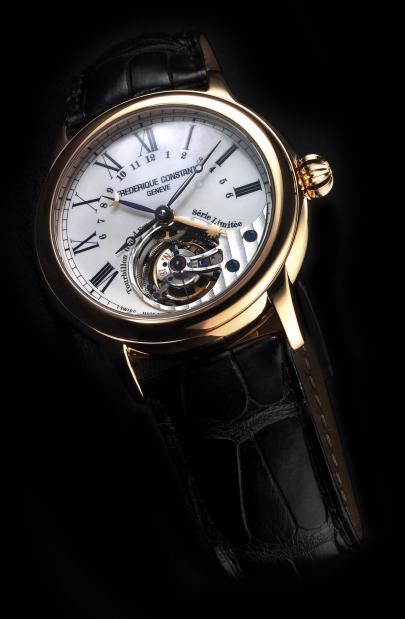
Frédérique Constant è orgogliosa di presentare il nuovo Manufacture Tourbillon Grand Feu. Il suo quadrante smaltato a mano diventerà sicuramente una rarità molto ricercata. Oggi, i quadranti in vero smalto vengono prodotti da pochissime manifatture che hanno alle spalle una tradizione straordinariamente ricca.
La smaltatura è una tecnica antica in cui si applica su una lastra di metallo una polvere finissima di vetro colorato. La lastra di metallo con la polvere di vetro viene poi messa in forno, ad una temperatura sufficientemente alta per fondere il vetro. Questo processo di smaltatura dà origine ad una bella superficie lucida e profonda.
Solo alcune delle lastre resisteranno in forno ad una temperatura di oltre 900 gradi Celsius e produrranno una superficie piana. La minima imperfezione nel mix di polvere, nella lastra metallica di supporto o un granello di polvere rovinerebbe il quadrante e lo smaltatore dovrebbe ricominciare tutto da capo.
Calibro Manufacture Tourbillon
Partendo dal premiato calibro Heart Beat Manufacture, Frédérique Constant ha sviluppato internamente il suo Tourbillon, dotandolo di alcune caratteristiche uniche:
– Silicio per la ruota di scappamento e la leva.
– Ripartizione ottimale del peso.
– Oscillazione veloce a 28.800 alternanze/ora.
– Gabbia del Tourbillon numerata.
Ruota Di Scappamento In Silicio
La ruota di scappamento e la leva in silicio hanno tre vantaggi principali:
Marcia senza lubrificazione
– Il lubrificante non si ridurrà a causa dell’invecchiamento né si essiccherà.
– Una ruota di scappamento senza lubrificante evita il rischio che l’olio si diffonda ad altre parti del movimento.
Inerzia minima
– La ruota di scappamento accelera e si ferma ad ogni tic tac dell’orologio. Il minor peso della ruota di scappamento in silicio produce minore inerzia e quindi maggiore efficienza energetica.
Buone proprietà di attrito
– Il minore attrito riduce la perdita di energia, quindi il fabbisogno energetico del calibro è inferiore.
Con i suoi tre vantaggi principali rispetto a una normale ruota di scappamento, una ruota di scappamento in silicio è particolarmente utile in un meccanismo a tourbillon. In particolare, il minor peso della ruota di scappamento in silicio e le migliori proprietà di attrito danno origine a un’efficienza sostanzialmente maggiore in termini di energia. Di conseguenza, il Tourbillon Frédérique Constant con ruota di scappamento in silicio ha un’ampiezza di oltre 300 gradi nelle posizioni a quadrante in alto e quadrante in basso. Anche nella posizione con corona in giù, l’ampiezza è di oltre 275 gradi, un risultato decisamente migliore rispetto a quello di altri tourbillon di alta gamma.
Ripartizione Ottimale Del Peso
La gabbia del Tourbillon Frédérique Constant è formata da 80 parti. Ciascuna di queste parti viene realizzata con la tolleranza più alta possibile, e con una precisione di 1-2 micron (0,001- 0,002 mm). Molte parti sono realizzate con la macchina CNC ad altissima precisione di Frédérique Constant a Plan-les-Ouates. La macchina CNC, di ultima generazione, ha una tolleranza di 1 micron sugli assi X e Y e di 2 micron sull’asse Z. Pur con un tale grado di precisione, è impossibile distribuire il peso nelle parti individuali in maniera perfettamente equilibrata. Affinché un Tourbillon funzioni in modo preciso, è essenziale che vi sia una distribuzione uguale del peso. Frédérique Constant ha risolto questo problema con un sistema brevettato di “Vite intelligente” sul bordo esterno della gabbia del Tourbillon. All’inizio, sulla gabbia del tourbillon viene collocato un leggero sovrappeso opposto al sistema “Vite intelligente” sulla ruota principale della gabbia. Da quel momento in poi, un maestro orologiaio altamente esperto è in grado di equilibrare il peso nel centro della gabbia del Tourbillon, aggiungendo o scambiando piccolissimi anelli di metallo sotto le due viti nella ruota principale della gabbia. Di solito, gli orologiai hanno bisogno di 8 ore per regolare i piccoli anelli ed equilibrare perfettamente il peso nell’intera gabbia del Tourbillon.
Oscillazione Rapida
Il Tourbillon Frédérique Constant si muove alla velocità di 4 Hertz, mentre il bilanciere batte 28.800 volte all’ora. Quindi, in un Tourbillon Frédérique Constant, il bilanciere oscilla 28.800 volte all’ora e l’ingranaggio si muove in avanti 691.200 volte in 24 ore. In quattro anni, questo equivale a oltre un miliardo di impulsi.
Molti tourbillon dei marchi concorrenti si muovono solo alla velocità di 3 Hertz. I più alti ‘Beats per Hour’ (BpH- battiti all’ora) permettono una maggiore precisione del calibro del Tourbillon. La maggiore oscillazione rende anche il calibro meno soggetto agli effetti della rotazione.
Numero Di Serie Individuale
Ciascuna gabbia del Tourbillon reca un numero individuale a riprova dell’Edizione Limitata di 188 pezzi. La minuscola platina in alto al centro della gabbia del tourbillon viene numerata in modo sequenziale sulla macchina CNC di Frédérique Constant. Il numero sulla gabbia corrisponderà al numero di Edizione Limitata sulla cassa, rendendo unica la combinazione di calibro e cassa.
Edizione Limitata a 188 esemplari.
Movimento – Automatico Calibro FC-980. Tourbillon un minuto. Ponte del bilanciere sul lato del quadrante. Diametro 30,50 mm (13 ¼ ). 28.800 A/h. 33 rubini. Sistema anti-shock Incabloc. Bilanciere in Glucydur. 1 molla a spirale Nivarox. Riserva di carica 48 ore. Ponti decorati a Côtes de Genève e perlage, finitura anglage e rhodiage. 188 componenti. Ogni movimento è numerato individualmente.
Funzioni – Ore, minuti, secondi, indicatore giorno-notte.
Cassa – Oro Rosa 18 carati, forma arrotondata, formata da tre parti. Diametro 42 mm. Spessore 11 mm. Fondello avvitato con 6 viti. Ogni cassa è numerata individualmente.
Quadrante – Vero smalto. Pregiati numeri romani neri. Lancette in acciaio nero. Indicazione giorno/notte in oro rosa e acciaio azzurrato.
Vetro – Zaffiro convesso antiriflesso, fondello cassa in vetro zaffiro antiriflesso.
Impermeabilità – 3 ATM (30 metri).
Cinturino – Vero alligatore cucito a mano con rivestimento impermeabile. Fibbia supplementare pieghevole inclusa.
Source / Fonte: Frédérique Constant
Fonte: Luxury & Fine Timepieces – Facebook
Hublot Oceanographic 4000, pressione estrema
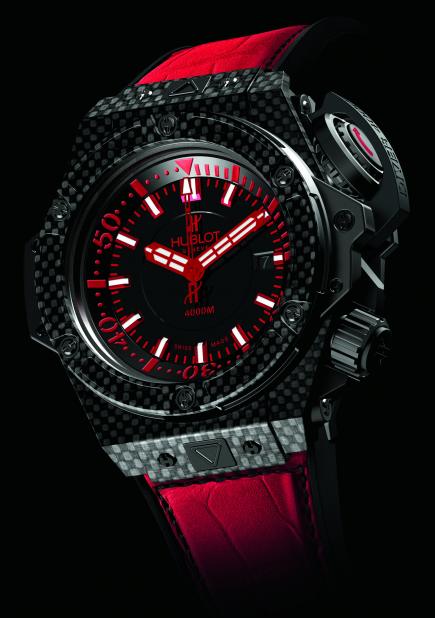
È un orologio simbolo. Quello dei 4.000. Destinato a stabilire i nuovi limiti del razionale, del possibile. Sono occorsi 18 mesi di ricerche, sviluppo e test per poter presentare l’Oceanographic 4000, un orologio in grado di scendere ad una profondità di 4.000 metri: una pressione estrema, un eccezionale livello tecnologico.
In occasione della 4a edizione di Only Watch, Hublot è lieta di contribuire all’evento presentando un inedito ed esclusivo “Oceanographic 4000″. Esclusivo in quanto è il primissimo esemplare di una famiglia di orologi supertecnologici che non sono ancora stati distribuiti, sviluppati da Hublot affinché potessero raggiungere la profondità estrema di 4000 metri. Inedito perché, per differenziarlo da quelli che lo seguiranno, questo modello esibisce un’estetica particolarmente adatta al Principato, grazie agli indici rossi e bianchi come i colori di Monaco.
L’Océanographique 4000 prende inoltre il suo nome direttamente dal Museo Oceanografico di Monaco, con cui Hublot è in collaborazione. Si tratta quindi di una creazione perfetta per il Principato dove si svolge e in cui ha avuto origine l’iniziativa Only Watch.
Movimento – Meccanico a carica automatica HUB1401. N. di componenti 180. Rubini 23. Ponti – Satinati, smussati e lucidati. Viti – PVD nero. Bariletto – A molla rinforzata. Scappamento – Spirale Glucydur. Riserva di carica Circa 42 ore.
Cassa – “King Power”. Diametro 48 mm. Fibra di carbonio opaca. Lunetta – Fibra di carbonio opaca. 6 viti in titanio PVD nero a forma di H. Disco anse – Resina composita nera. Inserti laterali – Resina composita nera. Fondello – Titanio satinato micropallinato con trattamento PVD nero. Corona – Titanio PVD nero con inserto in caucciù nero. Viti – Titanio PVD nero.
Quadrante – Nero opaco. Indici rossi con SuperLuminova™ bianco.
Lancette – Rosse con SuperLuminova™ bianco.
Vetro – Zaffiro con trattamento antiriflesso.
Impermeabilità – 400 ATM (4000 metri).
Cinturino – Alligatore rosso cucito su caucciù nero.
Chiusura – Fibbia ad ardiglione in titanio PVD nero.
Source / Fonte: Hublot
Fonte: Luxury & Fine Timepieces – Facebook



 LA PROMENADE Cult
- Valentino Garavani, muore l’imperatore della moda
- Crans-Montana, lutto oltre ogni possibile apparenza
- Italexit Per l’Italia Abruzzo – Marius Creati sostiene la famiglia nel bosco
- Giorgio Armani, muore l’ultimo re della moda internazionale
- Emilio Fede, muore l’ex direttore del Tg4
- Scuola.Zero – Progetto di Educazione Parentale, Francavilla al Mare (CH)
- Pippo Baudo, muore il re della tv italiana simbolo di Sanremo
- Ozzy Osbourne, muore il famoso frontman dei Black Sabbath
- 6a Biennale D’Arte Contemporanea di Salerno
- Alvaro Vitali, muore un volto noto della cosiddetta “commedia sexy all’italiana”

La Promenade du Temps
- Sedia neo barocca degli anni 50, un classico estemporaneo
- MERRY CHRISTMAS & HAPPY NEW YEAR 2025
- Allegra cornice artigianale con specchio fumé anticato d’antan
- Lampadario vintage in ottone e legno anni ’50 in stile neo vittoriano glamour
- “Una notte sul Titanic sul fondo dell’oceano…” incantevole letto d’antan anni ’40 in uno stile shabby materico tra profondo blu e tramonto solare
- Euforie di angioletti di gesso…
- Scudo con cranio di giovane cervo rosso, originale esempio di tassidermia in onore a Cernunnos
- Specchio impero anni ’40 su consolle vintage anni ’50/’60… en un ensemble encroyable!
- Putto decorativo tridimensionale très jolie in resina
- Testa di David, rivisitazione d’antan di un classico sempiterno

Les Fleurs de La Promenade
- “Quarantena” di Marius Creati
- Ciclo Corsini, estratto di poesie di Marius Creati
- “Padre mio” di Marius Creati
- Fashion Couture e Seduzione, disegni di moda di Marius Creati
- Fashion Couture e Seduzione, disegni di moda di Marius Creati
- “Segni”, poesia di Marius Creati
- Fashion Couture e Seduzione, disegni di moda di Marius Creati
- Fashion Couture e Seduzione, disegni di moda di Marius Creati
- Aforisma di Marius Creati
- Fashion Couture e Seduzione, disegni di moda di Marius Creati

LA PROMENADE Vip
- Crans-Montana, lutto oltre ogni possibile apparenza
- MERRY CHRISTMAS & HAPPY NEW YEAR 2025
- MERRY CHRISTMAS & HAPPY NEW YEAR 2023
- Ilary Blasi e Francesco Totti, amori in dissolvenza sinonimo di società liquida
- Madonna… il suo catalogo non è in vendita!
- Merry Christmas & Happy New Year 2021
- Robin Williams, svelata causa di morte del celebre attore
- Naomi Campbell, annuncio arrivo della sua prima figlia
- Merry Christmas & Happy New Year 2020
- Stella McCartney x Taylor Swif, capsule in arrivo con l’album Lover


MONDORARO
- Trump, la Groenlandia e le navi ospedale fantasma…
- Il teatro della mente: quando i nostri personaggi interiori salgono sul palco
- Chiude il primo tabacchino storico ad Alfedena, se ne va un pezzo di quotidianità
- “Samurai Cop: la giustizia ha i capelli lunghi, la giacca di pelle e zero credibilità”
- “Scimmie alla Casa Bianca”: l’ennesima provocazione di Donald Trump e il razzismo che l’America non ha mai davvero sepolto
- Alfedena digitalizza la gestione del personale: attivata la nuova piattaforma cloud per le presenze
- Alfedena, rinnovata la convenzione per le pulizie del Municipio: affidato il servizio per il 2026
- Sicurezza sul lavoro: il Comune di Alfedena affida il servizio di consulenza e formazione per il 2026
- Alfedena sostiene il doposcuola: liquidato il contributo all’associazione “Mani Colorate”
- Il Comune di Alfedena rinnova il servizio privacy: affidato a Maggioli S.p.A. l’incarico di Responsabile della Protezione dei Dati


La Promenade by Marius Creati is licensed under a Creative Commons Attribuzione - Non opere derivate 3.0 Unported License.
Based on a work at lapromenademag.com.
Permissions beyond the scope of this license may be available at http://lapromenadenet.wordpress.com/la-promenade-network/.










 La Promenade, BlogZine di Informazione