Archive
Greubel Forsey Quadruple Tourbillon Invention Piece 2
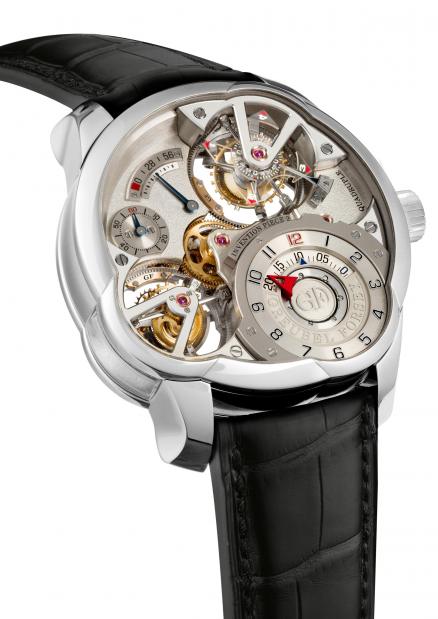
Unique edition of 11 pieces in platinum and 11 pieces in 5n red gold.
Movement – Mechanical hand-wound movement. Calibre GF03n.
Movement dimensions – Diameter 37.0 mm. Cage diameter 36.40 mm. Thickness 11.87 mm.
Number of parts – Complete movement: 594 composants. 1 double tourbillon cage: 129 composants. Weight of one double cage: 1.17 g.
Number of jewels – 64. Olived-domed jewels in gold chatons.
Power reserve – 56 hours.
Barrels – Rapid rotating triple barrels (1 turn in 3.2 hours). Equipped with a slipping spring to avoid excess tension.
Balance wheel – Free sprung balance with white gold mean-time screws (10.70 mm diameter).
Frequency – 21’600 vibrations/hour.
Balance spring – Phillips terminal curve. Geneva-style stud.
Main Plates – Nickel silver, spotted nickel-palladium fi nish, hand bevelled, straight-grained flanks, polished counter-sinks.
Bridges – Nickel silver bridge, frosted, spotted with polished bevelling, nickel-palladium finish. Gold nameplate bearing the individual number of the timepiece. 4 steel Double Tourbillon bridges hand-bevelled, flat black polished with polished counter-sinks.
Gearing – Involute circle profile. Conical gearing with corrected profiles.
Inner Tourbillon – Inclined at a 30°angle, 1 rotation per minute.
Outer Tourbillon – 1 rotation in 4 minutes. Hand-bevelled and openworked cage pillars. 1 gold Greubel Forsey counterweight per cage.
Displays – Hours and minutes. Small seconds sub dial (mean performance). 56-hour power reserve on a sector. Tourbillon rotation sapphire crystal indicator (outer cage) in 4 minutes at 1 o’clock.
Exterior
Case – Platinum 950 or 18k 5N red gold with asymmetrical convex sapphire crystal. Transparent back with asymmetrical convex sapphire crystal. Lateral window with shaped sapphire crystal. Gold security screws. Polished bezel and centre band with hand-fi nished straight graining. Hand-engraved individual number. Raised engraving of the name of the Inventors on a hand-punched background. Unique edition of 11 pieces in platinum and 11 pieces in 5N red gold.
Case dimensions – Diameter 43.50 mm. Thickness 16.28 mm.
Water resistance of the case – 3 atm – 30 m – 100 ft.
Crown – Platinum or 5N red gold with engraved and black lacquered GF logo.
Dial – 22k gold hour indicators with red triangle. 22k gold Greubel Forsey initials in centre.
Hands – Minute-indicator: rotating disc with fixed blue triangle. Small second in flame-blued polished steel. Power-reserve in flame-blued polished steel. Sapphire crystal 4-minute indicator.
Strap and clasp – Hand-sewn black alligator. Platinum 950 or 18k 5N red gold folding clasp, hand-engraved with the Greubel Forsey logo.
Source: Greubel Forsey
Fonte: Luxury & Fine Timepieces – Facebook
Hublot Formula 1™ King Power Ceramic [Limited Edition], soltanto 500 esemplari

Dopo lo straordinario successo dei modelli F1 King Power (nelle versioni zirconio e King Gold) e F1™ King Power Tourbillon (anche questo nelle versioni zirconio e King Gold), Hublot ha presentato il terzo modello di questa prestigiosa serie, il F1™ King Power Ceramic.
La ceramica, materiale ideale per l’orologeria, è del 30% più leggera dell’acciaio, totalmente antiallergica, inalterabile e inossidabile. Il F1™ King Power Ceramic, prodotto in un’edizione limitata di 500 esemplari numerati, è un cronografo con due pulsanti (Start e Reset), contatore delle 12 ore alle ore 6 e dei 30 minuti alle ore 3 e piccoli secondi alle ore 9. La cassa da 48 mm di diametro è realizzata in ceramica nera micropallinata.
Sul quadrante spicca il logo ufficiale della Formula 1™ mentre la speciale lunetta in fibra di carbonio è ornata da un esclusivo anello in ceramica traforata che si ispira ai dischi dei freni ad alte prestazioni. Il cinturino, infine, è composto da due strati cuciti con filo rosso: quello interno è in caucciù nero naturale mentre quello esterno è in Nomex™,, una fibra sintetica sviluppata da Dupont De Nemours utilizzata, per la sua bassissima combustibilità, nella produzione delle tute indossate dai piloti.
Il F1™ King Power Ceramic, Orologio Ufficiale della Formula 1™, è il risultato di una stretta e costante collaborazione tra i team di Bernie Ecclestone, CEO del gruppo Formula 1, e di Jean-Claude Biver, CEO di Hublot. Molti elementi del suo design si ispirano visibilmente al mondo della Formula 1™ coniugando un sofisticato know-how e i processi di produzione più innovativi a materiali high tech.
Serie 500 esemplari numerati da 01/500 a 500/500.
Movimento – Calibro HUB4100. Cronografo meccanico a carica automatica. N. di componenti 252. Rubini 27. Ponti – Micropallinati smussati lucidati. Viti PVD nero. Calendario – Finestrella alle ore 4.30. Massa oscillante – PVD nero ricoperto con segmento in carburo di tungsteno pesante. Platina – Rodiata con finitura circolare. Bariletto – A molla rinforzata. Scappamento – Spirale Glucydur. Riserva di carica – Circa 42 ore.
Cassa – King Power – Diametro 48 mm in ceramica nera micropallinata.
Lunetta – Carbonio e ceramica nera ispirata ai dischi dei freni ad alte prestazioni. 6 viti in titanio PVD nero a forma di H in rilievo.
Anse Lunetta – Resina composita nera.
Inserti Laterali – Resina composita nera.
Fondello – Ceramica nera micropallinata.
Corona – Titanio PVD nero con inserti in caucciù nero.
Pulsanti – Start a ore 2 con inserti in caucciù rosso e testo nero e Reset a ore 4, caucciù nero e testo rosso.
Viti – Titanio PVD nero.
Quadrante – Nero opaco a pezzi multipli con indici in nichel nero, SuperLuminova™ rosso e logo Formula 1™ alle ore 12.
Lancette – Nichel nero satinato e SuperLuminova™rosso.
Vetro – Zaffiro con trattamento antiriflesso.
Impermeabilità – 10 ATM o circa 100 metri.
Cinturino – Cinturino regolabile in caucciù nero e Nomex con logo F1TM e cucitura rossa.
Chiusura – Fibbia deployante King Power titanio PVD nero micropallinato, protezione in titanio PVD nero micropallinato, piastra di decorazione in ceramica nera micropallinata.
Fonte: Luxury & Fine Timepieces – Facebook
Omega Seamaster 1948 Co Axial London 2012 Limited Edition
Il nuovo Omega Seamaster 1948 Co Axial London 2012 Limited Edition viene realizzato per onorare il lancio del primo modello Seamaster risalente al 1948, ultimo anno in cui Londra ha ospitato i Giochi olimpici.
Per omaggiare le Olimpiadi del 2012, dunque, questo nuovo capolavoro di alta orologeria sarà presentato con giusto un anno di anticipo rispetto alla Cerimonia d’apertura a Londra; Omega, ai prossimi Giochi olimpici di Londra, avrà per la venticinquesima volta il ruolo di cronometrista ufficiale dell’evento.
L’orologio Omega Seamaster 1948 Co Axial London 2012 Limited Edition si presenta come espressione di eleganza ai più alti livelli, proprio come lo era tanti anni fa nella sua prima apparizione; la cassa, dal diametro di 39 mm, è in acciaio lucido e satinato.
La corona è impreziosita dal logo Omega, mentre la lunetta e le anse si presentano con una finitura lucida dal gusto decisamente vintage. Il fondello riporta uno stemma in oro giallo 18 carati con logo in rilievo dei Giochi olimpici di Londra.
Il quadrante opalino argentato, riporta invece il logo Omega vintage in oro bianco 18 carati, con numeri arabi a ore 12, 3, 6 e 9; le due lancette principali sono lucidate a diamante, mentre la piccola lancetta dei secondi in acciaio azzurrato.
L’aspetto esteriore del nuovo Omega Seamaster 1948 Co Axial London 2012 Limited Edition, richiama con decisione lo stile del suo antenato, ma all’interno della cassa è tutto cambiato. Questo nuovo orologio, infatti, è azionato dal raffinato calibro Omega 2202, un cronometro dotato di scappamento Co-Axial a tre livelli, come si può intuire dal nome.
L’orologio in questione sarà prodotto in edizione limitata di soli 1948 pezzi, abbinato ad un pregiato cinturino in pelle nera, chiuso da una fibbia anch’essa in acciaio lucido; il tutto sarà completato da uno speciale astuccio con sopra raffigurata una particolare presentazione dei Giochi olimpici 2012 di Londra.
La referenza di questo nuovo orologio è 522.23.39.20.02.001
Per altre informazioni, basta visitare il sito omegawatches.com
Fonte: GoLook.it
Vacheron Constantin Patrimony Traditionnelle World Time
A longstanding part of the Vacheron Constantin watchmaking heritage, the World Time complication is making a noteworthy comeback to the collections from the Manufacture. The Patrimony Traditionnelle World Time model houses the new Calibre 2460WT bearing the prestigious Hallmark of Geneva. Developed and manufactured by Vacheron Constantin, this new mechanical self-winding movement is distinguished by its capacity to indicate the world’s 37 time zones, including those offset from Universal Coordinated Time (UCT) by a half – or quarter-hour – an exclusive mechanism patented by Vacheron Constantin.
The new Patrimony Traditonnelle World Time by Vacheron Constantin marks the return to the collection of a complication inextricably bound to the history of the Geneva-based manufacturer. The latter is also interwoven with the theme of travel, since Jean-Marc Vacheron and his successors have constantly circled the globe delivering their exceptional timepieces. A pioneer in the development and production of innovative watches, the Manufacture Vacheron Constantin has displayed the same approach in being resolutely open to the world at large. Created in 1755 in Geneva and able to look back over more than 255 years of uninterrupted activity, Vacheron Constantin soon began exploring the four corners of the earth. It established a presence in the United States in 1832 and in China in 1845 – well before the International Meridian Conference held in Washington in 1884 which divided the world into 24 time zones, taking the Greenwich meridian as the longitude 0 point of reference. This new approach became indispensable in keeping step with the development of international travel and of railways.
The rich history of World Time at Vacheron Constantin – In keeping with the same pioneering spirit, and driven by a wish to demonstrate that the multiple time-zone watch could be further perfected, Vacheron Constantin introduced its first timepieces endowed with an international time mechanism in 1932. This movement was the work of a brilliant Geneva watchmaker, Louis Cottier, who had imagined and developed a mechanical movement indicating the 24 time zones from 1 to 24 by means of a disc rotating around the central dial and the outer bezel bearing the names of the world’s major cities. This first Vacheron Constantin World Time “Cottier system” watch (reference 3372) enabled simultaneous read-off of the time in 31 cities around the world. It marked the start of a rich and longstanding relationship between Vacheron Constantin and the World Time complication. In 1936, Vacheron Constantin presented two new versions of its World Time model with a 31-city dial (reference 3650) and a 30-city dial (reference 3638) without Cairo. In 1937 and 1938, the Geneva-based Manufacture unveiled six table clocks with a mobile dial featuring 67 locations, including summer and winter time in Paris. From the 1940s onwards, Vacheron Constantin attributed the reference number 4414 to a world time model with a 41-city dial and a day/night division of the mobile 24-hour disc. During the 1940s and 1950s, many famous customers were captivated by this useful and ingenious mechanism, and contributed to spreading the fame of this new complication.
In 1957, Vacheron Constantin wrote a new chapter in its history of World Time watches by introducing the first World Time wristwatch, reference 6213, ordered by an Egyptian dignitary. It was the first of a long line of models incorporating this remarkable complication and that earned it an outstanding reputation among connoisseurs and collectors.
A patented new World Time calibre – Eager to make a major new contribution to the history of this complication, the Vacheron Constantin master-watchmakers and engineers have sought to create a mechanical movement capable of indicating not only the full time zones, but also the partial ones, so as to reflect the exact temporal reality in the 37 time zones. A number of countries have indeed adopted a half-hour or quarter-hour difference from UTC, and the Calibre 2460WT by Vacheron Constantin takes account of these specific characteristics. By way of example, it provides the correct time indication for Caracas, since Venezuela decided in 2007 to switch from a full time zone to a half time zone (GMT – 4:30).
The indication of the 37 time zones as proposed by Vacheron Constantin in its Patrimony Traditionnelle World Time is as complete as one could wish for. The display consists of three dials: a sapphire dial with a unique day/night shading; a metal dial with a “Lambert projector” type map; and a metal chapter ring. Beating at a frequency of 4 Hz (28,800 vibrations per hour) and endowed with a 40-hour power reserve, mechanical self-winding Calibre 2460WT drives displays of the hours, minutes, central seconds and World Time. It enables simultaneous read-off of the time in all regions of the world, along with the day/night indication provided by the central world map. All indications are adjusted via the crown, thus considerably simplifying the use of this highly technical watch. In light of these exclusive developments, a patent has been filed for the new Vacheron Constantin Calibre 2460WT bearing the prestigious Hallmark of Geneva.
Appreciable user friendliness – Despite its complex construction principles, the new mechanical World Time movement is extremely user-friendly. The wearer chooses the reference time and places it opposite the black triangle at 6 o’clock. The time in the reference location can then be read off either by the hour hand, or by the 24-hour disc, while the time in the other 36 time zones is simultaneously readable. The cities shown in black represent the full time zones, while the cities in red indicate half-hour or quarter-hour zones.
Incorporating all the signature characteristics of the collection – a slender bezel, a knurled motif on the case-back, a screw-down sapphire crystal case-back, and dauphine hands – the new Patrimony Traditionnelle World Time comes with a 42.5 mm diameter 18K pink gold case that is water-resistant to 30 metres. It is fitted with a brown alligator leather strap secured by an 18K pink gold folding clasp.
Due to the modern nature of this useful complication, along with the major innovations provided by its Calibre 2460WT, the Patrimony Traditionnelle World Time is destined to become an iconic model within the collection, and to perpetuate Vacheron Constantin’s pioneering role in the development of multiple time-zone watches.
Movement – Calibre 2460 WT, developed and manufactured by Vacheron Constantin. Stamped with the Hallmark of Geneva. Energy – Mechanical, self-winding. Movement – Diameter 36.60 mm (11’’’ ¼). Movement thickness – 8.10 mm. Jewels 27. Frequency – 4Hz (28’800 Vibrations/hour). Power reserve – Approximately 40 hours.
Indications – Hours, minutes and center seconds. World time indication with day/night zone (37 time zones).
Case – 18K 5N Pink gold. 42.50 mm in diameter. Open-worked back with transparent sapphire crystal.
Dial – The display is made of 3 dials: 1 dial in sapphire with day / night indication in the center, 24-hour indications inked & engraved. 1 dial in metal with “Lambert Projection” type map and transfered cities names. 1 externalring in metal with transferred minute-track and gold applied hour-markers.
Water-Resistance – 3 bar (about 30 meters).
Strap – Brown hand-stitched, saddle-finish, large square scaled Mississippiensis alligator leather.
Clasp – 18K 5N pink gold triple blade folding clasp. Polished half Maltese Cross.
Source: Vacheron Constantin
Fonte: Luxury & Fine Timepieces – Facebook
Jaeger-LeCoultre Memovox Tribute to Deep Sea
There are some watches that leave an indelible trace on our collective memory because they have written a page in history. The Memovox Deep Sea, the first diver’s watch ever made by the Manufacture Jaeger-LeCoultre, undoubtedly belongs to the select circle of such milestone instruments. After presenting in 2008 two faithful interpretations of historical diver’s watches, the Memovox Tribute to Polaris 1965 and the Memovox Tribute to Polaris 1968, the Grande Maison in the Vallée de Joux is pursuing its journey through time and returning to the very roots of the diver’s watch by introducing a re-edition of the 1959 Memovox Deep Sea, logically named Memovox Tribute to Deep Sea. The distinctive characteristic of the original model lay in the fact that it was interpreted in two versions: one intended for European sports enthusiasts and the other for American divers. In homage to its rich past and to the delight of fine watchmaking connoisseurs, the Manufacture Jaeger-LeCoultre is unveiling a faithful limited-series re-edition of the two 1959 Memovox Deep Sea models.
Rebirth of an icon – The Memovox Tribute to Deep Sea faithfully replicates the original model, except in one respect: the stainless steel case has been slightly enlarged from 39.8 to 40.5 mm in order to match contemporary requirements – and wrists. The case-back carries the motif appearing on the 1959 watch, featuring a frogman surrounded by bubbles. And, as one would expect from a new creation paying homage to its illustrious predecessors, the Memovox Tribute to Deep Sea also comes in two versions, each bearing the appearance of one of the historical variations. While the European model features a matt black dial with luminescent hour-markers, its American counterpart is distinguished by a two-tone black/grey execution surrounded by an external ring comprising a scale with five-minute graduations and simply signed “LeCoultre”. The two versions offer the same range of functions: hours, minutes, central seconds and an alarm. A crown at 2 o’clock serves to wind and set the alarm, while another at 4 o’clock is used to wind the movement and set the time. Both models are driven by Memovox Calibre 956, an automatic movement incorporating the latest technological developments from the Manufacture and which has decisively demonstrated its reliability over the years. This descendant of the first manually-wound Memovox calibre beats at a rate of 28,800 vibrations per hour and is endowed with a 45-hour power reserve.
The first diver’s watch instrument – In the early 1950s, humankind was fervently dedicated to building a new world. Modern individuals were dynamic and intrepid, embodying the values of a future-oriented era and keen to set off on the discovery of new territories focusing on the unexplored heart of continents, the infinity of the cosmos, and the ocean depths. In 1957 the USSR launched the first artificial satellite of the Earth. A few months earlier, Jacques-Yves Cousteau and Louis Malle had unveiled the fascinating mysteries of underwater life in the film entitled The Silent World and which was acclaimed by critics at the Cannes Film Festival and subsequently by the public at large. Commander Cousteau’s passion was soon shared by a growing number of eager scuba diving fans, especially once the simultaneous invention of a revolutionary diving bottle fostered the spread of this promising young discipline. A new kind of sports enthusiast emerged, requiring instruments suited to the exercise of their recently developed passion and able to help them successfully undertake their adventurous missions below the sea.
In order to meet demand from American enthusiasts of this booming sport, Jaeger-LeCoultre launched a daring project in 1959 involving the development of a diver’s watch. This represented largely uncharted territory at the time, with no criteria stipulating the demands that should be met by this unprecedented category of timepieces, and almost 20 years were to elapse before the adoption of the NIHS norms applicable to diver’s watches. The watchmakers and technicians of the Manufacture immediately set to work and that same year presented a watch endowed with a degree of reliability and performances that were truly exceptional in that early period of underwater exploration. The Memovox Deep Sea was the world’s first diver’s watch equipped with an alarm function. Jaeger-LeCoultre engineers devoted the full measure of their inventive skills to transforming the alarm generally featured on Memovox watches into an acoustic signal designed to warn divers that it was time to begin their progressive ascent to the surface. In keeping with an essential principle consistently upheld by the Manufacture, functionality was already dedicated to serving security.
The new timepiece in both versions met with spectacular success on either side of the Atlantic. This iconic diver’s watch soon sold out and became a legend of which only a rare few collectors were able to glimpse the reality.
The Memovox tribute to Deep Sea is issued in two limited series: 959 reproducing the “Jaeger-LeCoultre Classique 1959” intended for the European market; and 359 inspired by the “LeCoultre Spécial Amérique 1959”. The last two digits of each edition echo the birth year of this legendary watch. And finally, driven by a determination to pay homage to one of the treasures of the company heritage, the watchmakers of the Manufacture have chosen to protect the dial of the Memovox Tribute to Deep Sea with a Plexiglas watch glass absolutely identical to that which equipped the historical models – exactly the kind of detail that connoisseurs will appreciate at its true worth.
Memovox Tribute to Deep Sea Replica of the “Jaeger-LeCoultre Classique 1959” –
Movement – Mechanical automatic movement, Jaeger-LeCoultre Calirbe 956, crafted, assembled and decorated by hand. 28,800 vibrations per hour. 23 jewels. 7.45 mm high. 268 parts. 45-hour power reserve.
Functions – Hours, minutes, central seconds and alarm.
Dial – Matt black with luminescent hour-markers. Alarm indication by a triangle with a luminescent centre.
Case – Steel. 40.5 mm in diameter. Convex plexiglas watch glass. Water-resistance – 10 bar.
Strap – Black leather with steel pin buckle.
Memovox Tribute to Deep Sea Replica of the “LeCoultre Spécial Amérique 1959” –
Movement – Mechanical automatic movement, Jaeger-LeCoultre Calibre 956, crafted, assembled and decorated by hand. 28,800 vibrations per hour. 23 jewels. 7.45 mm high. 268 parts. 45-hour power reserve.
Functions – Hours, minutes, central seconds and alarm.
Dial – Matt black and grey. Alarm indication by a triangle with a luminescent centre.
Case – Steel. 40.5 mm in diameter. Convex plexiglas watch glass. Water-resistance – 10 bar.
Strap – Black leather with steel pin buckle.
Source: Jaeger-LeCoultre
Fonte: Luxury & Fine Timepieces – Facebook
Audemars Piguet Millenary 4101, beauty and sophistication
Above and beyond the first impression of technical beauty and sophistication, this watch sparks natural curiosity. Is it a skeletonised watch? No, it did not involve openworking the movement parts to let the light through. So has the dial simply been pierced in order to reveal part of the mechanism? Not exactly, and nor was it just a matter of making openings in the mainplate so as to see through it. In any case, one thing is for sure: the watchmakers from Le Brassus have accomplished the feat of putting an object on your wrist that is more movement than watch.
They are thereby fulfilling the dream of all watchmaking devotees: extracting the fine mechanism from the cavity of its case to reveal it in all its splendour. This means there is no longer any need to turn the watch over to admire the movement through a sapphire crystal caseback, because the movement of the Millenary 4101 has actually been built to show itself face upwards. An intriguing notion that is sure to satisfy the curiosity of the most discerning aesthetes and connoisseurs! This fascinating spectacle is staged within the perimeter of a shaped case – and not just any case, but the voluptuous and sophisticated oval that makes the Millenary collection so truly unique.
Revealing the beating heart of the watch – Have you ever savoured the magic of certain homes in which the surrounding garden seems to be an integral part of the living areas, as if the foliage of the trees extended into the lounge, and the settee and coffee table appear to be set amongst the greenery? The Millenary 4101 exercises the same fascination as this holistic architecture. It blurs the borders between inside and outside. It overturns existing ideas, and in particular that which holds that the design involves the exterior of the watch – dial, case and wristband – and thus its outer garment, while the inside is essentially functional. Things are very different on this model, in which the inside and outside form a seamless whole merging functionality and design. In terms of development and production, this naturally implies intense cooperation between the teams at work, resulting in two highly original models, one in stainless steel with a black crocodile leather strap, and the other in pink gold with a brown crocodile leather strap, and both masterfully combining form and content.
Calibre 4101, entirely designed, developed and produced in-house, was built in such a way that the elements normally concealed on the back are now visible from the front. The regulating organ – composed of the balance, lever and escapement – has been reworked in order to meet this goal. It is located at 9 o’clock and offers a truly eye-catching sight. Its variable-inertia balance asserts a powerful presence with its eight inertia-blocks, its golden colour and the distinctive aesthetic of its cross-through bridge. The discerning eye will even detect the lever and the escape-wheel.
Moreover, no less than 12 bridges have been cleverly arranged on the surface of the movement. In addition to their functional role, which consists in holding the various parts in place, they also serve as attractive design elements, including by tracing three beautiful parallel curves on the dial side. Their decorative motifs – horizontal Côtes de Genève, circular graining; and snailing on the “trottoirs” – play with the different movement levels to accentuate the contrasts and depth effects. The screws on the left-hand side of the dial underscore the oval shape of the case and create a more technical and richer overall impression. The same goes for the hemispherical convex and particularly sparkling jewels punctuating the 10, 11 and 12 o’clock numerals on the dial.
In this manner, various elements relating to the movement structure and its functional role in fact play a premier role in the overall aesthetic appeal of the watch. They merge as one with the signature characteristics of the Millenary collection represented by the oval case subtly accentuated by the contrast between the brushed case middle and the polished bezel, as well as the offset subdial with Roman numerals. The watch is thus viewed as a sophisticated whole distinguished by its three-dimensional, high-tech design. The Millenary 4101 thereby pursues an exploratory process that began several years ago and has been exemplified through models such as the Tradition d’Excellence N°5, the Millenary with deadbeat seconds and the Millenary MC 12.
Reliability, timing precision and finishing quality – The oval Calibre 4101, as we have seen, is distinguished by an ingenious structural approach that turns the parts upside down and plays a key role in the overall design of the watch. Nonetheless, these visual qualities must not eclipse its excellent reliability. The heart of the movement is a variable-inertia balance with eight white gold inertia-weights that ensures improved long-term rating stability. Equipped with a Breguet balance-spring, it beats at an oscillation frequency of 4 Hz, meaning 28,800 vibrations per hour. This oscillation frequency, along with the higher inertia of the balance, improves the timing precision and also makes the regulating organ less sensitive to external disturbing factors. The cross-through balance-bridge ensures improved shock resistance due to the fact that it is secured not just on one side, but on either side of the mainplate.
Winding is ensured by a 22-carat gold oscillating weight mounted on ceramic ball bearings. The reverser mechanism ensuring bidirectional winding is also composed of a ceramic ball-bearing system. An effective antidote to wear and also useful in avoiding any locking, the system is conducive to optimal winding speed. The mainspring thus wound is able to release its energy in a more regular manner and to positively influence rating precision.
Hand-decorated and assembled in the Le Brassus workshops, Calibre 4101 boasts exceptionally high-quality execution and finishing. The movement of the steel version has an elegantly understated colour achieved by an anthracite galvanic treatment, while that of the pink gold version is rhodiumed and gilded. The bridges are meticulously bevelled and polished so as to display only clean-cut, gleaming edges. The jewel sinks are diamond-polished. The wheels have bevelled spokes and diamond-polished sinks. Even the screw rim and slots are bevelled. The mainplate is decorated on both sides: Côtes de Genève on the front and circular-graining in two different sizes on the back in order to create greater contrast and depth effects. The bridges on the dial side feature horizontal Côtes de Genève, snailing and circular graining, while the bridges on the back are distinguished by circular Côtes de Genève, snailing and circular graining. Finally, the 22-carat gold oscillating weight is adorned with the Audemars and Piguet family crests and the AP monogram.
Movement – Proprietary selfwinding Calibre 4101. Overall dimensions – (width/length: 37.25 x 32.90 mm). Casing diameter – (width/length: 36.75 x 32 mm). Thickness: 7.46 mm. 34 jewels. 253 parts. Bidirectional winding 22-carat gold oscillating weight mounted on ceramic ball bearings. 60-hour power reserve. Cadence of the balance: 28,800 vibrations per hour (4 Hz). Variable-inertia balance with eight inertia-blocks and Breguet overcoil balance-spring. Screw-down mobile balance-spring stud-holder.
Finishing – All parts decorated by hand; mainplate adorned with horizontal Côtes de Genève on the front and circular-grained on the back; bridges rhodiumed, bevelled, snailed and adorned with horizontal and circular Côtes de Genève and with circular graining: Diamond-polished jewel sinks; diamond-polished countersinks and bevelled wheel spokes; bevelled screw rims and slots. AP monogram as well as Audemars and Piguet family crests engraved on the oscillating weight.
Functions – Hours and minutes. Small seconds.
Cases – Stainless steel or 18-carat pink gold. Dimensions – (width/length: 47 x 42 mm). Thickness 13 mm. Sapphire crystal caseback.
Dials – Directly fixed to the bridges. Black and anthracite with applied pink gold Roman numerals. Pink gold hands.
Water resistance – 20 m.
Straps – Hand-sewn black or brown crocodile leather with large square scales, secured by an AP folding clasp in stainless steel or 18-carat pink gold.
Source: Audemars Piguet
Fonte: Luxury & Fine Timepieces – Facebook
Concord C2, cronografo in stile neo-black urbano

Una nuova opera di casa Concord, profondamente ispirata allo stile neo-black urbano, perfettamente espresso nei più innovativi yacht di lusso o nelle auto sportive di una certa aggressività, apprezzate da una fascia di mercato all’avanguardia, particolarmente attenta al design.
Stiamo parlando del nuovo cronografo Concord C2, concepito con un’estetica profondamente futuristica, ma con linee che calcano la firma della marca, ammirata nel mondo per la sua innovatività.
Il cinturino alla cassa, interamente in acciaio trattato PVD, è attaccato saldamente tramite tubolari orizzontali.
La cassa è leggermente più sottile degli altri modelli, con un diametro da 43 mm e vetro zaffiro spesso 2 mm; si possono notare le viti a vista e la fibbia déployante a tre lame. Il fondello, inoltre, garantisce resistenza ed impermeabilità fino a 100 metri (10 atmosfere).
Per ciò che concerne il movimento, parliamo di un meccanico ad alta precisione con 28 rubini che compie 28.800 alternanze in un’ora, elaborando un’ampia gamma di utili indicazioni; tra queste sono presenti la data e le funzioni del cronografo, perfettamente visibili dal quadrante a tre settori. Quest’ultimo è caratterizzato da una raffinata finitura con sabbiatura e granitura circolare
Il tutto è completato dalle lancette e dagli indici luminosi disposti in maniera precisa all’interno della ghiera, rispettando i canoni dello stile Concord.
Il Concord C2 in versione con dettagli rossi, è caratterizzato da un vistoso dischetto rotante situato a ore tre con un indice cremisi; il colore è ripreso da altri particolari, tra cui il cinturino in gomma vulcanizzata caratterizzato da piccole linee parallele interne di colore rosso.
Le referenze del nuovo Concord C2, sono rispettivamente 0320138 per la versione con dettagli neri e 0320141 per la versione con dettagli rossi.
Per altre informazioni, basta visitare il sito concord.ch
Fonte: GoLook.it
TrackDay Quarto di Miglio, nuovo cronografo
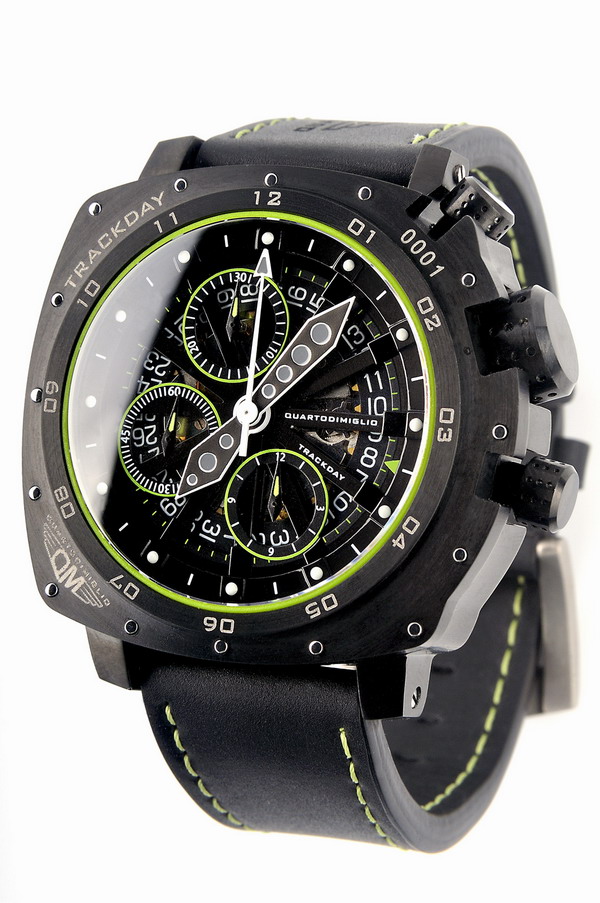
E’ sempre ricorrente il forte richiamo al mondo dello sport e delle corse all’interno della collezione di Quarto di Miglio ed anche il modello TRACKDAY lo conferma. Un cronografo con un design all’avanguardia che suscita passione, energia e forte temperamento.
TRACKDAY ha una cassa molto leggera in titanio ed un quadrante aereo che lascia intravedere la meccanica; il quadrante a livelli, è completamente scheletrato in tipico stile “naked” con ruota calendario a vista dove la data è subito identificabile da un triangolo rosso.
Il vetro è in zaffiro è bombato ed ha uno spessore di 4,00 mm. I pulsanti a corona, dalle generose dimensioni, sono “disassati” e sono posizionati verso l’alto. Le finiture sono in acciaio e in titanio. Il modello TRACKDAY monta un movimento automatico svizzero VALJOUX 7750, con ore, minuti, secondi, secondi crono, minuti crono e ore crono.
Le lancette hanno la particolarità di avere i bordi colorati. Il cinturino del modello TRACKDAY è in gomma con una fibbia in titanio. TRACKDAY è un segnatempo semplice e vincente grazie ad un mix di qualità dei materiali e design d’avanguardia.
Fonte: BlogModa
Bell&Ross BR 01 Red Radar [Limited Edition], percezione inedita del lusso
Ispirato Ai Radar Del Controllo Aereo
Nel 2010 il BR 01 Radar di Bell & Ross offriva una nuova percezione del tempo proponendo una modalità di lettura inedita, ispirata a uno strumento aereo: il radar.
Nella sua costante ricerca di innovazione e di performance, Bell & Ross propone nel 2011 una nuova interpretazione della sua visualizzazione a radar spingendo ancora oltre i mimetismi dello strumento originale.
La lettura analogica del BR 01 Red Radar riprende quella del radar di controllo aereo con un realismo di grande impatto. La sua grafica mette in evidenza l’effetto dei fasci luminosi di un vero e proprio schermo radar. Questa nuova versione stravolge nuovamente i tradizionali codici di lettura dell’ora:
– Le lancette e il quadrante si fondono su uno stesso piano. Al loro posto, tre dischi concentrici indipendenti sono contrassegnati da 3 fasci rossi. Alla base di questi fasci luminosi dal progressivo dégradé di colore possono leggere le ore, i minuti e i secondi a mano a mano che l’occhio si sposta verso il centro del quadrante.
– Sul vetro di colore rosso, due assi graduati e gli indici indicano la misurazione del tempo.
– La scelta del rosso sul fondo nero opaco antiriflesso del quadrante e della cassa ripropone gli schermi delle sale di controllo aereo offrendo un suggestivo contrasto che permette una leggibilità ottimale.
Una Prodezza Tecnica
Nonostante la sua apparente semplicità, il BR 01 Red Radar è un orologio altamente sofisticato. La sfida tecnica posta dalla sua concezione e la sua realizzazione hanno richiesto la collaborazione dei migliori ingegneri orologiai.
– Poiché ciascun disco pesa 30 volte il peso di una lancetta, si è reso necessario creare dei dischi ultraleggeri per non diminuire la riserva di carica, né la precisione dell’orologio. Inoltre, ogni disco è stato reso sufficientemente resistente per non deformarsi e non rischiare il minimo attrito. Questa doppia sfida ha richiesto la messa a punto di materiali specifici e di nuove tecniche.
– Durante la rotazione, una regolazione alla precisione di un micron garantisce in modo costante il parallelismo dei dischi. La precisione del montaggio esige tutto il know-how dei maestri orologiai.
Con il BR 01 Red Radar, Bell & Ross supera, ancora una volta, il classico concetto di lettura dell’ora, rispettando in maniera fedele la visualizzazione degli schermi del controllo aereo.
Edizione Limitata a 999 esemplari.
Movimento – Meccanico automatico ETA 2892. Sistema di lettura mediante dischi.
Funzioni – Ore, minuti, secondi.
Cassa – Diametro 46 mm. Acciaio con finiture PVD nero. Corona a vite.
Quadrante-Indici – Lettura del tipo «schermo radar», composta da 3 dischi neri concentrici. La marcatura sul disco esterno indica le ore, quella sul disco intermedio i minuti e quella sul disco centrale i secondi.
Vetro – Minerale, tinto di rosso, rinforzato da uno strato di protezione. Ore e minuti graduati.
Impermeabilità – 100 metri.
Cinturini – Caucciù e tela sintetica ultraresistente.
Fonte: Luxury & Fine Timepieces – Facebook
Vergo Avius Leonardo [Limited Edition], avventura straordinaria
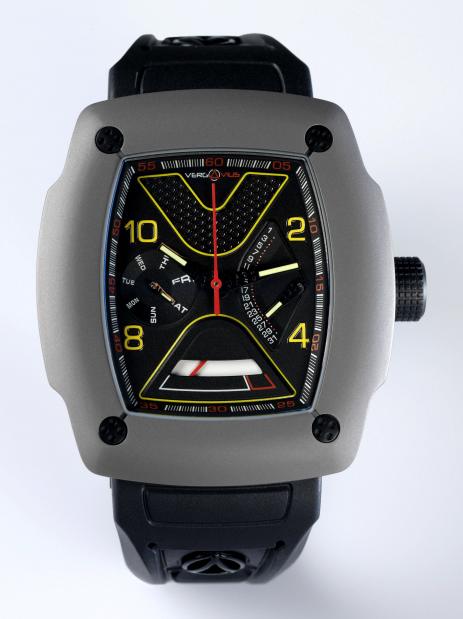
Vergo: essere rivolto, guardare verso, estendersi, tendere, essere propenso.
Avius: lontano, luogo remoto, fuori dalla strada, inaccessibile.
Il coraggio di guardare lontano.
Lo strumento di misura del protagonista di quella straordinaria avventura che è l’esplorazione dell’ignoto, di colui che vuole concepire e governare la propria idea di progresso. Sul concetto di tale idea nasce la volontà di creare un oggetto fuori dal comune, uno strumento in grado di definire il carattere della persona che lo possiede e lo custodisce.
Vergo Avius nasce da un gruppo di talenti artistici provenienti da settori diversi, quali il mondo dell’alta orologeria, del design, della micromeccanica, delle arti figurative e della fotografia. Questi artisti hanno lavorato in sinergia per un obbiettivo comune mettendo a disposizione la propria creatività, le singole attitudini professionali e le conoscenze provenienti da differenti esperienze artistiche.
Navigando attraverso possibili correnti ideologiche, percorrendo nuove strade, sperimentando nuove situazioni e proiettando lo sguardo verso il futuro, hanno tracciato una nuova rotta e sono riusciti a creare un approccio innovativo fatto di manualità artigianale e di ingegneria sperimentale concretizzando, con una reale volontà di cambiamento, un segnatempo in grado di distinguersi inequivocabilmente dalla serialità.
Nel percorso creativo e costruttivo, partendo dall’idea fino alla realizzazione dei particolari più complessi, Vergo Avius si è avvalsa delle migliori tecnologie presenti sul mercato ed ha scelto fin dal principio, per le sue realizzazioni, collaboratori d’eccellenza.
E’ per questo che il valore dell’azienda risiede anche nella capacità di intrattenere un rapporto di scambio e di continuo confronto con i suoi partners nell’intento di preservare un livello qualitativo in linea con le aspettative del marchio.
Gli orologi Vergo Avius sono realizzati in Edizione Limitata a 99 esemplari per ciascuna delle tre versioni.
Movimento – Meccanico a carica automatica ETA 2892 con modulo aggiuntivo Soprod 9094 per data retrograda, riserva di carica e giorno della settimana. Oscillazioni 28.800 per ora. Riserva di marcia 42 ore. 30 Rubini. Bilancere – Glucydur. Spirale – Anachrom. Molla – Nivaflex M. Sistema di assorbimento urti – Incabloc.
Funzioni – Ore, minuti e secondi centrali. Riserva di carica ad ore 6. Indicatore della data retrograda ad ore 3. Indicazione del giorno della settimana ad ore 9.
Cassa – 3 versioni in una speciale lega di alluminio usata in Formula 1: PVD nero, PVD Gun Metal e PVD Sky Chrome. Fondello / Lunetta – Titanio Grado 5, fissato con quattro viti. Corona – Con chiusura a vite.
Quadrante – Multi-layer con finitura satinata, rete a nido d’ape diamantata e nichelata. Indici numerici applicati con trattamento SuperLuminova. Lancette – Con finitura in nickel e trattamento SuperLuminova.
Vetro – Zaffiro con doppio trattamento antiriflesso.
Impermeabilità – 10 ATM (100 metri).
Cinturino – In tecno-polimero anallergico. Fibbia deployante in titanio a doppia sicurezza.
Fonte: Luxury & Fine Timepieces – Facebook



 LA PROMENADE Cult
- Valentino Garavani, muore l’imperatore della moda
- Crans-Montana, lutto oltre ogni possibile apparenza
- Italexit Per l’Italia Abruzzo – Marius Creati sostiene la famiglia nel bosco
- Giorgio Armani, muore l’ultimo re della moda internazionale
- Emilio Fede, muore l’ex direttore del Tg4
- Scuola.Zero – Progetto di Educazione Parentale, Francavilla al Mare (CH)
- Pippo Baudo, muore il re della tv italiana simbolo di Sanremo
- Ozzy Osbourne, muore il famoso frontman dei Black Sabbath
- 6a Biennale D’Arte Contemporanea di Salerno
- Alvaro Vitali, muore un volto noto della cosiddetta “commedia sexy all’italiana”

La Promenade du Temps
- Sedia neo barocca degli anni 50, un classico estemporaneo
- MERRY CHRISTMAS & HAPPY NEW YEAR 2025
- Allegra cornice artigianale con specchio fumé anticato d’antan
- Lampadario vintage in ottone e legno anni ’50 in stile neo vittoriano glamour
- “Una notte sul Titanic sul fondo dell’oceano…” incantevole letto d’antan anni ’40 in uno stile shabby materico tra profondo blu e tramonto solare
- Euforie di angioletti di gesso…
- Scudo con cranio di giovane cervo rosso, originale esempio di tassidermia in onore a Cernunnos
- Specchio impero anni ’40 su consolle vintage anni ’50/’60… en un ensemble encroyable!
- Putto decorativo tridimensionale très jolie in resina
- Testa di David, rivisitazione d’antan di un classico sempiterno

Les Fleurs de La Promenade
- “Quarantena” di Marius Creati
- Ciclo Corsini, estratto di poesie di Marius Creati
- “Padre mio” di Marius Creati
- Fashion Couture e Seduzione, disegni di moda di Marius Creati
- Fashion Couture e Seduzione, disegni di moda di Marius Creati
- “Segni”, poesia di Marius Creati
- Fashion Couture e Seduzione, disegni di moda di Marius Creati
- Fashion Couture e Seduzione, disegni di moda di Marius Creati
- Aforisma di Marius Creati
- Fashion Couture e Seduzione, disegni di moda di Marius Creati

LA PROMENADE Vip
- Crans-Montana, lutto oltre ogni possibile apparenza
- MERRY CHRISTMAS & HAPPY NEW YEAR 2025
- MERRY CHRISTMAS & HAPPY NEW YEAR 2023
- Ilary Blasi e Francesco Totti, amori in dissolvenza sinonimo di società liquida
- Madonna… il suo catalogo non è in vendita!
- Merry Christmas & Happy New Year 2021
- Robin Williams, svelata causa di morte del celebre attore
- Naomi Campbell, annuncio arrivo della sua prima figlia
- Merry Christmas & Happy New Year 2020
- Stella McCartney x Taylor Swif, capsule in arrivo con l’album Lover


MONDORARO
- “Lavinia fuggita”: musica, parola e mistero nella Venezia del Settecento
- Gaza: War ends where Humanity begins. Mostra di G.Karloff ad Alfedena da maggio ad agosto 2026
- Castel di Sangro, sviluppo e identità: l’opposizione non sia nostalgia
- Elodie e Franceska, un amore che non ha bisogno di etichette: la forza della libertà
- Quando il male diventa progetto: il caso del 17enne, la seduzione della violenza e la futilità distruttiva dell’odio
- Hannibal Lecter, il cannibale più famoso della fiction: differenze, errori e forzature tra film e romanzi
- Famiglia nel bosco, il libro di Catherine Birmingham e il dubbio inevitabile: il “risveglio” passa anche dal contratto editoriale?
- Castel di Sangro, perché mi piace la lista di Angelo Caruso: concretezza, visione e attenzione al territorio
- Pizzaballa fermato al Santo Sepolcro: Israele sotto accusa, Herzog parla di “incidente”
- Migranti Ue, il Parlamento apre ai rimpatri nei Paesi terzi: l’Europa sceglie la linea dura


La Promenade by Marius Creati is licensed under a Creative Commons Attribuzione - Non opere derivate 3.0 Unported License.
Based on a work at lapromenademag.com.
Permissions beyond the scope of this license may be available at http://lapromenadenet.wordpress.com/la-promenade-network/.










 La Promenade, BlogZine di Informazione