Archive
Audemars Piguet Snow Golf Exhibition, nuovo evento golf sulla neve a Courmayeur

E’ un evento del tutto nuovo che solo Audemars Piguet poteva realizzare. Per la prima volta a Courmayeur si potrà giocare a golf sulla neve. Dall’8 al 10 febbraio, infatti, nella prestigiosa cittadina di montagna si terrà l’Audemars Piguet Snow Golf Exhibition, una tre giorni speciale dedicata al gioco del golf con gare e momenti di relax e degustazioni di vini pregiati, tutto sotto la cornice del Monte Bianco. L’evento ha, tra l’altro, l’obiettivo di trasformare il golf in uno degli sport invernali praticabili sulla neve, per conquistare nuovi giocatori, appassionati e curiosi. Ogni giorno si disputerà una gara, secondo regole che non si distanziano molto da quelle del golf classico. La neve sarà lievemente battuta, per impedire alle palline, vivacemente colorate, di affondare e di andare perdute. La formula adottata sarà quella del “pich&putt”, modalità di gioco veloce e divertente in cui l’handicap di ogni giocatore viene ridotto in virtù della lunghezza del campo, più corta rispetto alla norma.
Fonte: VM-Mag
Audemars Piguet Jules Audemars Extra-Thin, exceptional timepiece
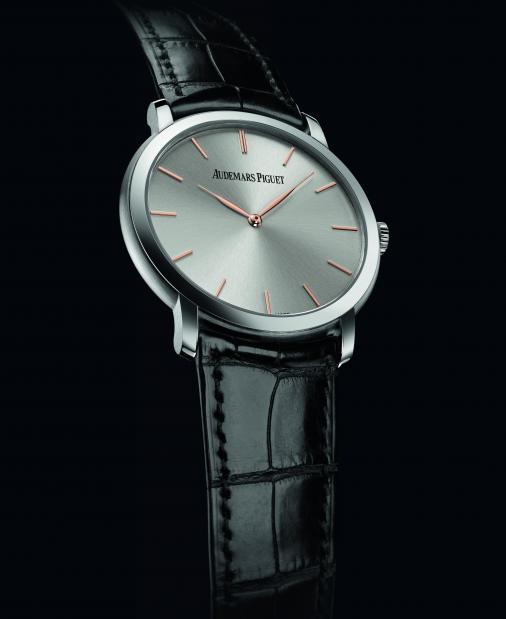
In 2011, Audemars Piguet has entirely reviewed the fundamentals of the Jules Audemars collection, its moon-phase calendar and dual timezone models, as well as its simple selfwinding watches including those with a date display. The Jules Audemars extra-thin watch houses one of the world’s thinnest selfwinding movements measuring just 2.45 mm thick. Its slender case, streamlined bezel and pure dial generate genuine emotion of the kind surrounding objects that are built to last, because this timepiece is endowed with that special something that is in fact the natural elegance of authentic classics.
A region, a culture: a collection
The models in the Jules Audemars collection represent the very roots of Audemars Piguet. This collection tells the story of an exceptional place and some exceptional people. The place is the Vallée de Joux, and the people are those who have nurtured Fine Watchmaking in this remote region. Well before the timepieces from this valley were exported to the four corners of the world, everything was already in place. From the mid-18th century onwards, alongside the farming work they undertook during the summer, the local population devoted many hours to building watch movements. They spent their long harsh winters at the workbench in order to fulfil orders from Geneva-based companies. They later began making their own movements and entire watches. The boldest of them founded manufactories, or Manufactures as they became known.
The men of the Vallée had thus acquired the ability to conduct the entire process, from design through to production, using hand-craftsmanship techniques. This dexterity, this manual know-how was handed down from generation to generation. Today it is accompanied by technological progress and semi-industrial-scale production, and yet the watches nonetheless embody deeply rooted origins and culture.
Jules Audemars and Edward Piguet became officially associated in 1875 and created the Manufacture Audemars Piguet. Both were watchmakers and accomplished masters of their chosen profession that they cherished and constantly perfected. Building on their knowledge, they played a pioneering role and took up the challenge of making entire watches under one roof. The company they established has been active ever since and has remained in the hands of the founding families.
The Jules Audemars collection pays tribute to this firm by bearing the name of one of the founders. It recounts this legacy and is imbued with a profound awareness of its heritage yet without any sense of nostalgia. It reinterprets the past with a contemporary vision. Its quest is focused on simplicity and a refusal of anything superfluous or purely ornamental. This unaffected simplicity is indeed what makes it both naturally elegant and unmistakably modern.
Absolute elegance, inside and out
The round case is an archetype that tends to make one forget that the circle is the perfect shape par excellence. By opting for an extremely slender bezel, the Jules Audemars extra-thin reveals the full measure of its innate nobility. The white gold case appears light and almost ethereal. This narrow bezel ensures a maximum dial opening. Only the applied pink gold baton-shaped hour-markers and hands stand out against the decidedly understated silver-toned background. Not even a minute circle disturbs this epitome of formal purity.
The case owes its clear-cut, sleek lines to the ultra-thin selfwinding movement within: Calibre 2120. Measuring just 2.45 mm thick, including the thickness of the oscillating weight, it is indeed one of the world’s thinnest self-winding movements. Audemars Piguet’s efforts to reduce the thickness of its movements began at an early stage in its history, and were already rewarded in 1946 with the hand-wound Calibre ML measuring just 1.64 mm thick. This was followed in 1953 by the skeletonised ultra-thin Calibre 2003. All that remained was to apply this successful approach to a selfwinding movement, a feat achieved in 1967 with Calibre 1967 and stemming from cooperation between several prestigious companies. It has since been constantly perfected. Its enduring appeal lies in an atypical, modern and refined nature. In addition to its extreme slenderness, it boasts the ingenuity of its winding system and of its balance-wheel adjustment.
One of the distinctive features of this Calibre 2120 is its rotor fitted with a 21-carat gold oscillating weight. This weight serves to drive the winding system in such a way as to keep the barrel at an ideal level of performance. The mainspring is able to supply its energy in a constant manner and thereby has a positive influence on rating procession. Enhanced performance was also the concern that motivated the choice of a central rotor rather an integrated mini-rotor. The barrel stands out from certain others in that it is as if “suspended”, held only by the barrel bridge. It ensures a 40-hour power reserve, a noteworthy achievement in light of the thinness of the movement and the construction of the barrel. The movement can be wound in either direction thanks to a reverser. To keep the movement as thin as possible, the oscillating weight is not equipped with a ball bearing mechanism and the endshake is guided by a peripheral ring rolling on four jewelled runners fixed to the mainplate.
This system makes a highly distinctive noise during the rotation of the oscillating weight, a sound that will delight connoisseurs. The heart of the movement is a variable-inertia balance with six inertia-blocks that ensure more stable long-term rating. It is equipped with a flat balance-spring and beats at the rate of 19,800 vibrations per hour.
Calibre 2120 is also remarkable in terms of the extreme care lavished on crafting it. Manually assembled and decorated in the company workshops in Le Brassus, it is distinguished by the exceptional quality of its execution and finishing. The bridges are meticulously bevelled and polished so as to feature only cleanly-cut, gleaming edges. The jewel sinks are diamond-polished. The wheels have bevelled spokes and diamond-polished sinks. Even the screw rim and slots are bevelled. The mainplate is circular-grained on both sides – with two different diameters of circular graining so as to accentuate the depth effect – and the bridges are adorned with Côtes de Genève. The beauty of the oscillating weight, which is openworked to form the “AP” initials, sets the crowning touch to the decoration of this calibre.
Those who appreciate rare objects will marvel at this meticulous finishing work in admiring the movement through the sapphire crystal case-back. They will rediscover the pleasure of the infinitely small details that one keeps to oneself. And finally, in the Jules Audemars extra-thin watch, they will recognise the force of character capable of withstanding the changes of time and which represents the enduring strength of authentic great classics.
Movement – Proprietary ultra-thin, selfwinding Calibre 2120. Total diameter 28,40 mm (12 ¾ lignes). Casing diameter 28 mm. Thickness: 2.45 mm. 37 jewels. 214 parts. Power reserve – up to 40 hours. Cadence of the balance – 19,800 vibrations per hour (2.75 Hz).
Finishing – All parts finished by hand; mainplate rhodium-plated, bevelled and circular-grained; bridges adorned with Côtes de Genève.
Functions – Hours and minutes.
Case – 18-carat white gold. Diameter 41 mm. Thickness 6.7 mm. Water resistance – 20 m. Sapphire crystal.
Dial – Silvered with applied pink gold hour-markers. Pink gold hour and minute hands.
Strap – Hand-sewn black crocodile leather with large square scales, secured by an 18-carat white gold pin buckle.
Source: Audemars Piguet
Fonte: Luxury & Fine Timepieces – Facebook
Audemars Piguet Royal Oak Offshore Selfwinding Tourbillon Chronograph
In order to grasp the essence of the Royal Oak Offshore Selfwinding Tourbillon Chronograph, you need to pick up the watch with your eyes closed and only open them after turning it over. Housed within a case that strongly hints at its innate sturdiness, protected by a sapphire crystal and a solid back secured by eight polished steel screws, a true masterpiece is revealed: the new selfwinding Calibre 2897, equipped with a tourbillon and a chronograph. A set of 335 parts on which the manually adjusted, corrected, bevelled and decorated surfaces create a shimmering play on light and shade. The automatic winding is ensured by a peripheral oscillating weight, while its chronograph is equipped with a column wheel and its tourbillon optimises its rating precision. The Royal Oak Offshore Selfwinding Tourbillon Chronograph is in harmony with the finest watchmaking traditions, and yet turning it over reveals an eminently contemporary spirit. It displays a sophisticated and powerful design, that of the legendary Royal Oak Offshore collection, supported by a combination of blackcoloured materials: forged carbon for the case middle, ceramic for the bezel and rubber for the strap. A watch with two faces, an encounter between contrasts or a watchmaking union of opposites, the Royal Oak Offshore Selfwinding Tourbillon Chronograph is an amazing blend of two worlds.
A 100% in-house made movement – Calibre 2897 is a selfwinding movement entirely developed and produced by Audemars Piguet. It combines a tourbillon and a column-wheel chronograph. Its architecture is a tribute to the past. The rounded cut-out of the bridges, the S-shaped lever, the curves of the minutes-counter bridge and the characteristic toothing of the column wheel: everything about this mechanism displays consummate artistry, to the point of making us almost forget the functional aspect. The finishing of the various parts is also loyal to the grand traditions of Fine Watchmaking. Several surfaces shine with a perfect polish, known as a mirror or specular polish, which catches the light and results in exceptional optical effects achieved by various polishing operations involving a succession of files, buffs, burnishers and various abrasives. On all the interior and external corners, the sharp edges between the surface and the flanks are cut down to form polished bevels. This is the meticulous operation known as bevelling or chamfering, and which is entirely performed by hand on all parts. The bridges and mainplate are rhodiumed, bevelled, circular-grained, beadblasted and hand-drawn with file strokes. After each of the parts is finished and decorated, the watchmaker performs a first “trial” assembly in order to set them into motion. Everything is then dismantled and each part is meticulously cleaned, before proceeding to final assembly and casing up. It takes around 15 days to produce a finished movement, which is then subjected to a number of different tests.
The peripheral oscillating weight, an efficient and elegant solution – Automatic winding is ensured by a peripheral oscillating weight in 950 platinum, mounted on ball bearings. This choice serves to shift the weight of the rotor to the outer edge of the movement, thereby improving winding speed. A recess has been made in the case middle so as to ensure that this 180° oscillating weight can rotate a full 360°. It is also worth specifying that this large 180° segment is optimally sized to enhance the efficiency of the automatic winding. Moreover, because of its position on the periphery of the movement, it does not increase the overall thickness, which enables the movement to maintain a slimmer profile. It also offers the additional aesthetic advantage of entirely freeing up the reverse side of the movement and thus providing full views of the mechanism, and particularly its column wheel, through the transparent back of the watch.
The tourbillon, the most entrancing of all horological complications – Very few watch brands are capable of making their own tourbilllons. An acknowledged member of this select circle, the Manufacture Audemars Piguet has become a master in the art of defying the effects gravity and has over 16 movements equipped with a tourbillon. In 1986, it was already the first brand to offer an ultra-thin selfwinding tourbillon wristwatch. Representing watchmakers’ response to the laws of gravity, this invention serves to cancel out the disturbing effects of gravity on the movement’s most sensitive organs – the balance and spring assembly and the escapement – and to thereby achieve enhanced timing precision. To compensate for these disturbances, these organs are housed within a tiny feather-light mobile carriage that spins on its axis once a minute. The tourbillon with its blackened titanium bridge is visible through a dial cutout at 6 o’clock. Setting this tourbillon into motion represents a formidable technical challenge. A weight of just 0.017 grams serves to balance the carriage weighing a mere 0.45 g. Meanwhile, in terms of the lightness of the regulating organs themselves, the escapement weighs just 0.12 g. The experienced watchmaker devotes almost three days to assembling its 85 parts, while the overall movement takes over 15 days.
The chronograph, a constantly perfected mechanism – Calibre 2897 reveal its column wheel, an attribute of the finest mechanical movements and which serves to coordinate the start, stop and reset phases. An ingenious coupling yoke principle has been developed in order to avoid the chronograph hand jerking when the timing begins, a characteristic flaw of this type of mechanism. The development engineers have added a hook to the coupling yoke which thereby displays enhanced shock resistance when the chronograph is activated. The meticulous assembly and adjustment operations are entirely performed by hand and require particular care. The activation of the chronograph functions is thus carried out progressively in order to enable gentle and accurate tactile perception.
The inimitable design of the Royal Oak Offshore collection – The name Royal Oak Offshore has become a watchmaking legend synonymous with sporty masculinity. Once again, connoisseurs will delight in recognising the octagonal bezel punctuated by its eight trademark polished steel hexagonal screws. The bezel is reinforced by the choice of black ceramics and by its finishing, in which the vertical satin-brushing of the surface makes a powerful contrast with the polished chamfers in order to sharp edges and clean-cut angles. The characteristically imposing and noble case middle is made from forged carbon. While ceramics is known for its resistance and hardness, forged carbon is extremely light. This material widely used in the field of aeronautics was introduced by Audemars Piguet into the world of fine watchmaking. The technical nature of the details on the right side of the case further accentuate the case middle. The pushpieceguards are not part of the case but consist of two titanium parts secured to the case by four visible screws. The pushpieces themselves are composed of two parts: a base and a top that serves as a contact surface. Finally, the dial features the signature “Méga Tapisserie” motif symbolising this collection, composed of straight parallel lines and taut shapes. Its 6 o’clock opening serves to reveal the tourbillon. Even the grooved rubber strap complies with the established Royal Oak Offshore codes.
Movement – Selfwinding Calibre 2897 with tourbillon and column-wheel chronograph. Total diameter: (15½ lignes). Casing diameter – 31.40 mm. Thickness – 7.75 mm. 34 jewels. 335 parts. 65-hour power reserve. Cadence of the balance: 21,600 vibrations per hour (3 Hz). Variable-inertia balance with screws and balance-spring with Phillips terminal curve. Finishing – All parts finely hand decorated; bridges and mainplate rhodiumed, circular-grained, beadblasted and hand-drawn with file strokes; polished angles, bevelled screw rims and slots. Peripheral oscillating weight in circular satin-brushed 950 platinum.
Functions – Hours and minutes. Small seconds at 9 o’clock. Chronograph with central sweep-seconds hand, 30-minute counter (at 3 o’clock). Tachometric scale on the flange.
Case – Diameter 44 mm. Thickness 14 mm. Sapphire crystal caseback with Royal Oak Offshore engraving.
Dial – Black with exclusive “Méga Tapisserie” motif, silver-toned counters. Applied and facetted white gold hour-markers with luminescent coating. Black flange. White gold facetted hour and minute hands with luminescent coating.
Strap – Black rubber, adorned with two grooves. Titanium pin buckle.
Source: Audemars Piguet
Fonte: Luxury & Fine Timepieces – Facebook
Audemars Piguet Millenary 4101, beauty and sophistication
Above and beyond the first impression of technical beauty and sophistication, this watch sparks natural curiosity. Is it a skeletonised watch? No, it did not involve openworking the movement parts to let the light through. So has the dial simply been pierced in order to reveal part of the mechanism? Not exactly, and nor was it just a matter of making openings in the mainplate so as to see through it. In any case, one thing is for sure: the watchmakers from Le Brassus have accomplished the feat of putting an object on your wrist that is more movement than watch.
They are thereby fulfilling the dream of all watchmaking devotees: extracting the fine mechanism from the cavity of its case to reveal it in all its splendour. This means there is no longer any need to turn the watch over to admire the movement through a sapphire crystal caseback, because the movement of the Millenary 4101 has actually been built to show itself face upwards. An intriguing notion that is sure to satisfy the curiosity of the most discerning aesthetes and connoisseurs! This fascinating spectacle is staged within the perimeter of a shaped case – and not just any case, but the voluptuous and sophisticated oval that makes the Millenary collection so truly unique.
Revealing the beating heart of the watch – Have you ever savoured the magic of certain homes in which the surrounding garden seems to be an integral part of the living areas, as if the foliage of the trees extended into the lounge, and the settee and coffee table appear to be set amongst the greenery? The Millenary 4101 exercises the same fascination as this holistic architecture. It blurs the borders between inside and outside. It overturns existing ideas, and in particular that which holds that the design involves the exterior of the watch – dial, case and wristband – and thus its outer garment, while the inside is essentially functional. Things are very different on this model, in which the inside and outside form a seamless whole merging functionality and design. In terms of development and production, this naturally implies intense cooperation between the teams at work, resulting in two highly original models, one in stainless steel with a black crocodile leather strap, and the other in pink gold with a brown crocodile leather strap, and both masterfully combining form and content.
Calibre 4101, entirely designed, developed and produced in-house, was built in such a way that the elements normally concealed on the back are now visible from the front. The regulating organ – composed of the balance, lever and escapement – has been reworked in order to meet this goal. It is located at 9 o’clock and offers a truly eye-catching sight. Its variable-inertia balance asserts a powerful presence with its eight inertia-blocks, its golden colour and the distinctive aesthetic of its cross-through bridge. The discerning eye will even detect the lever and the escape-wheel.
Moreover, no less than 12 bridges have been cleverly arranged on the surface of the movement. In addition to their functional role, which consists in holding the various parts in place, they also serve as attractive design elements, including by tracing three beautiful parallel curves on the dial side. Their decorative motifs – horizontal Côtes de Genève, circular graining; and snailing on the “trottoirs” – play with the different movement levels to accentuate the contrasts and depth effects. The screws on the left-hand side of the dial underscore the oval shape of the case and create a more technical and richer overall impression. The same goes for the hemispherical convex and particularly sparkling jewels punctuating the 10, 11 and 12 o’clock numerals on the dial.
In this manner, various elements relating to the movement structure and its functional role in fact play a premier role in the overall aesthetic appeal of the watch. They merge as one with the signature characteristics of the Millenary collection represented by the oval case subtly accentuated by the contrast between the brushed case middle and the polished bezel, as well as the offset subdial with Roman numerals. The watch is thus viewed as a sophisticated whole distinguished by its three-dimensional, high-tech design. The Millenary 4101 thereby pursues an exploratory process that began several years ago and has been exemplified through models such as the Tradition d’Excellence N°5, the Millenary with deadbeat seconds and the Millenary MC 12.
Reliability, timing precision and finishing quality – The oval Calibre 4101, as we have seen, is distinguished by an ingenious structural approach that turns the parts upside down and plays a key role in the overall design of the watch. Nonetheless, these visual qualities must not eclipse its excellent reliability. The heart of the movement is a variable-inertia balance with eight white gold inertia-weights that ensures improved long-term rating stability. Equipped with a Breguet balance-spring, it beats at an oscillation frequency of 4 Hz, meaning 28,800 vibrations per hour. This oscillation frequency, along with the higher inertia of the balance, improves the timing precision and also makes the regulating organ less sensitive to external disturbing factors. The cross-through balance-bridge ensures improved shock resistance due to the fact that it is secured not just on one side, but on either side of the mainplate.
Winding is ensured by a 22-carat gold oscillating weight mounted on ceramic ball bearings. The reverser mechanism ensuring bidirectional winding is also composed of a ceramic ball-bearing system. An effective antidote to wear and also useful in avoiding any locking, the system is conducive to optimal winding speed. The mainspring thus wound is able to release its energy in a more regular manner and to positively influence rating precision.
Hand-decorated and assembled in the Le Brassus workshops, Calibre 4101 boasts exceptionally high-quality execution and finishing. The movement of the steel version has an elegantly understated colour achieved by an anthracite galvanic treatment, while that of the pink gold version is rhodiumed and gilded. The bridges are meticulously bevelled and polished so as to display only clean-cut, gleaming edges. The jewel sinks are diamond-polished. The wheels have bevelled spokes and diamond-polished sinks. Even the screw rim and slots are bevelled. The mainplate is decorated on both sides: Côtes de Genève on the front and circular-graining in two different sizes on the back in order to create greater contrast and depth effects. The bridges on the dial side feature horizontal Côtes de Genève, snailing and circular graining, while the bridges on the back are distinguished by circular Côtes de Genève, snailing and circular graining. Finally, the 22-carat gold oscillating weight is adorned with the Audemars and Piguet family crests and the AP monogram.
Movement – Proprietary selfwinding Calibre 4101. Overall dimensions – (width/length: 37.25 x 32.90 mm). Casing diameter – (width/length: 36.75 x 32 mm). Thickness: 7.46 mm. 34 jewels. 253 parts. Bidirectional winding 22-carat gold oscillating weight mounted on ceramic ball bearings. 60-hour power reserve. Cadence of the balance: 28,800 vibrations per hour (4 Hz). Variable-inertia balance with eight inertia-blocks and Breguet overcoil balance-spring. Screw-down mobile balance-spring stud-holder.
Finishing – All parts decorated by hand; mainplate adorned with horizontal Côtes de Genève on the front and circular-grained on the back; bridges rhodiumed, bevelled, snailed and adorned with horizontal and circular Côtes de Genève and with circular graining: Diamond-polished jewel sinks; diamond-polished countersinks and bevelled wheel spokes; bevelled screw rims and slots. AP monogram as well as Audemars and Piguet family crests engraved on the oscillating weight.
Functions – Hours and minutes. Small seconds.
Cases – Stainless steel or 18-carat pink gold. Dimensions – (width/length: 47 x 42 mm). Thickness 13 mm. Sapphire crystal caseback.
Dials – Directly fixed to the bridges. Black and anthracite with applied pink gold Roman numerals. Pink gold hands.
Water resistance – 20 m.
Straps – Hand-sewn black or brown crocodile leather with large square scales, secured by an AP folding clasp in stainless steel or 18-carat pink gold.
Source: Audemars Piguet
Fonte: Luxury & Fine Timepieces – Facebook
Audemars Piguet sponsor ufficiale del Teatro Bolshoi
 La famosa maison orologiera Audemars Piguet espone le sue larghe vedute al mondo dello spettacolo culturale e artistico diventando sponsor ufficiale, per i prossimi tre anni, del celeberrimo teatro Bolshoi di Mosca.
Afferma Philippe Merk, direttore generale di Audemars Piguet, “È una splendida opportunità per il nostro marchio associare la nostra immagine a quella del Teatro Bolshoi, istituzione secolare di dimensione internazionale, che incarna gli stessi valori di Tradizione, Eccellenza, Audacia della nostra Manifattura. Il Bolshoi è un simbolo forte della Russia e della sua cultura. Ha costruito la sua incredibile notorietà su basi simili alle nostre: creatività artistica, eccellenza e rigore dei suoi attori, qualità e originalità delle rappresentazioni proposte a Mosca ma anche nei più grandi teatri di tutto il mondo”.
Risponde Anatoly Iksanov, direttore generale del teatro Bolshoi, “Sono felice di avere fra i sostenitori e amici del Teatro Bolshoi una società così conosciuta e dall’ottima reputazione come Audemars Piguet. Penso che le nostre società condividano lo stesso modo di pensare: preservare le tradizioni, evolvendosi al passo con i nostri tempi, cercando sempre di trovare un equilibrio fra il nostro patrimonio storico e le tendenze moderne“.
Fiera ambasciatrice del marchio e favolosa étoile del suddetto teatro sarà Svetlana Zakharova.
by Marius Creati



 LA PROMENADE Cult
- Valentino Garavani, muore l’imperatore della moda
- Crans-Montana, lutto oltre ogni possibile apparenza
- Italexit Per l’Italia Abruzzo – Marius Creati sostiene la famiglia nel bosco
- Giorgio Armani, muore l’ultimo re della moda internazionale
- Emilio Fede, muore l’ex direttore del Tg4
- Scuola.Zero – Progetto di Educazione Parentale, Francavilla al Mare (CH)
- Pippo Baudo, muore il re della tv italiana simbolo di Sanremo
- Ozzy Osbourne, muore il famoso frontman dei Black Sabbath
- 6a Biennale D’Arte Contemporanea di Salerno
- Alvaro Vitali, muore un volto noto della cosiddetta “commedia sexy all’italiana”

La Promenade du Temps
- Sedia neo barocca degli anni 50, un classico estemporaneo
- MERRY CHRISTMAS & HAPPY NEW YEAR 2025
- Allegra cornice artigianale con specchio fumé anticato d’antan
- Lampadario vintage in ottone e legno anni ’50 in stile neo vittoriano glamour
- “Una notte sul Titanic sul fondo dell’oceano…” incantevole letto d’antan anni ’40 in uno stile shabby materico tra profondo blu e tramonto solare
- Euforie di angioletti di gesso…
- Scudo con cranio di giovane cervo rosso, originale esempio di tassidermia in onore a Cernunnos
- Specchio impero anni ’40 su consolle vintage anni ’50/’60… en un ensemble encroyable!
- Putto decorativo tridimensionale très jolie in resina
- Testa di David, rivisitazione d’antan di un classico sempiterno

Les Fleurs de La Promenade
- “Quarantena” di Marius Creati
- Ciclo Corsini, estratto di poesie di Marius Creati
- “Padre mio” di Marius Creati
- Fashion Couture e Seduzione, disegni di moda di Marius Creati
- Fashion Couture e Seduzione, disegni di moda di Marius Creati
- “Segni”, poesia di Marius Creati
- Fashion Couture e Seduzione, disegni di moda di Marius Creati
- Fashion Couture e Seduzione, disegni di moda di Marius Creati
- Aforisma di Marius Creati
- Fashion Couture e Seduzione, disegni di moda di Marius Creati

LA PROMENADE Vip
- Crans-Montana, lutto oltre ogni possibile apparenza
- MERRY CHRISTMAS & HAPPY NEW YEAR 2025
- MERRY CHRISTMAS & HAPPY NEW YEAR 2023
- Ilary Blasi e Francesco Totti, amori in dissolvenza sinonimo di società liquida
- Madonna… il suo catalogo non è in vendita!
- Merry Christmas & Happy New Year 2021
- Robin Williams, svelata causa di morte del celebre attore
- Naomi Campbell, annuncio arrivo della sua prima figlia
- Merry Christmas & Happy New Year 2020
- Stella McCartney x Taylor Swif, capsule in arrivo con l’album Lover


MONDORARO
- Gaza: War ends where Humanity begins. Mostra di G.Karloff ad Alfedena da maggio ad agosto 2026
- Castel di Sangro, sviluppo e identità: l’opposizione non sia nostalgia
- Elodie e Franceska, un amore che non ha bisogno di etichette: la forza della libertà
- Quando il male diventa progetto: il caso del 17enne, la seduzione della violenza e la futilità distruttiva dell’odio
- Hannibal Lecter, il cannibale più famoso della fiction: differenze, errori e forzature tra film e romanzi
- Famiglia nel bosco, il libro di Catherine Birmingham e il dubbio inevitabile: il “risveglio” passa anche dal contratto editoriale?
- Castel di Sangro, perché mi piace la lista di Angelo Caruso: concretezza, visione e attenzione al territorio
- Pizzaballa fermato al Santo Sepolcro: Israele sotto accusa, Herzog parla di “incidente”
- Migranti Ue, il Parlamento apre ai rimpatri nei Paesi terzi: l’Europa sceglie la linea dura
- Noelia Castillo Ramos, addio a 25 anni: la sua eutanasia chiude una lunga battaglia per il diritto di scegliere


La Promenade by Marius Creati is licensed under a Creative Commons Attribuzione - Non opere derivate 3.0 Unported License.
Based on a work at lapromenademag.com.
Permissions beyond the scope of this license may be available at http://lapromenadenet.wordpress.com/la-promenade-network/.










 La Promenade, BlogZine di Informazione